
Exploring the Mbari House with G.I. Jones
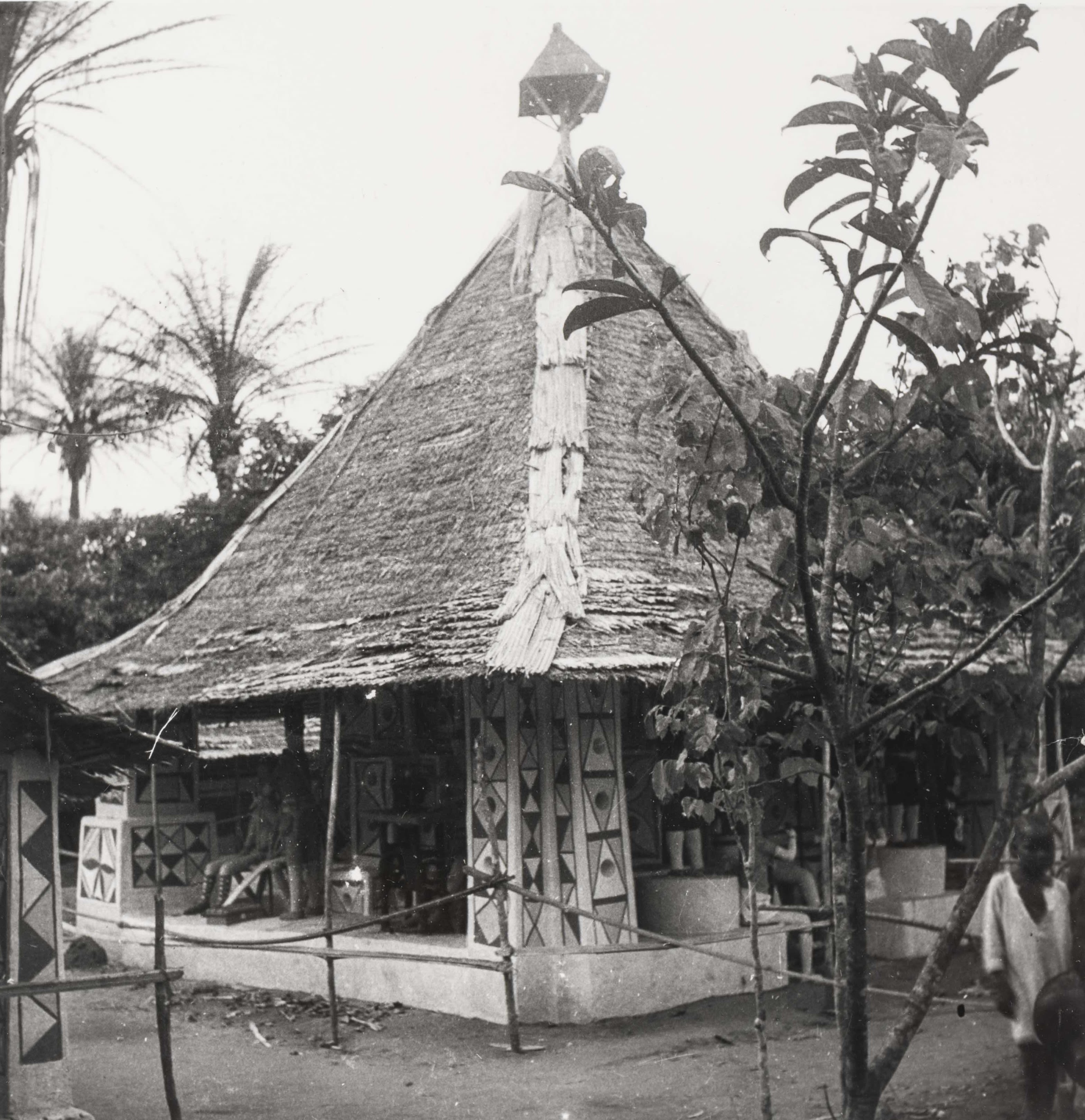

It’s 1936 in Southeastern Nigeria. The sun has just risen, the light is bright and clear, but soon the air will become humid and the sky grey. You’re walking along a path through Ulakwo, an Igbo village set in tropical forest in Owerri district. All around you hear the hubbub of people and animals.
You turn a corner and suddenly there is a strange building. It’s spectacular; from every angle it’s full of painted sculptures and surfaces, a kaleidoscope of dramatic colours and mesmerising patterns. You’re looking at a special house, a house for the spirits on whom the village and its farms depends.
This is their Mbari house.

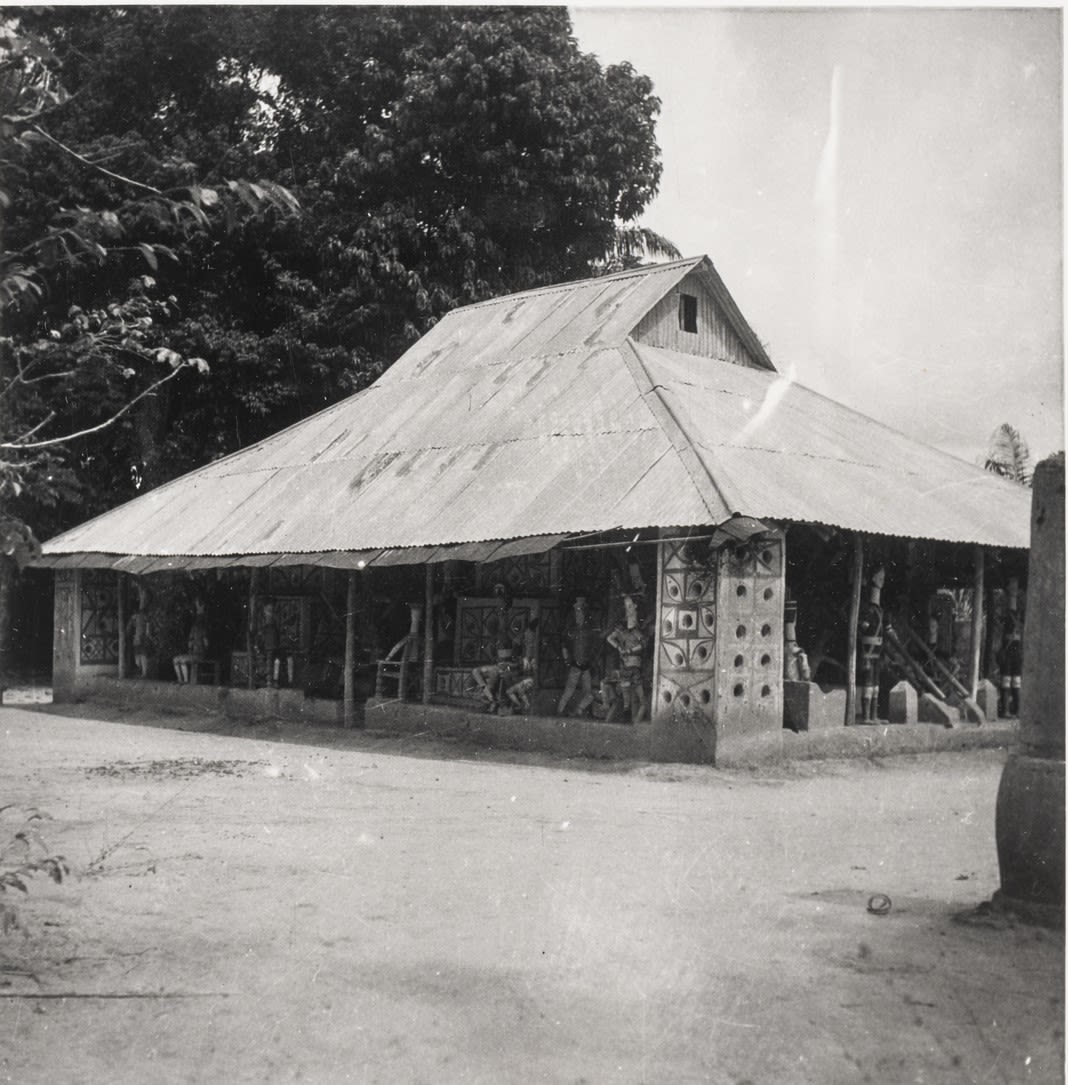
An Mbari house is built to placate the deity Ala (the earth goddess) or Amadioha (the god of thunder). These deities, along with other spirits, are believed to control the well-being of the village. If they are angered, the village may suffer. The village priest and diviners determine when a deity demands an Mbari. The entire community then contributes to the Mbari house that provides shelter and comfort for the deity so that they will protect them, help them to be prosperous, and their farms to be productive.

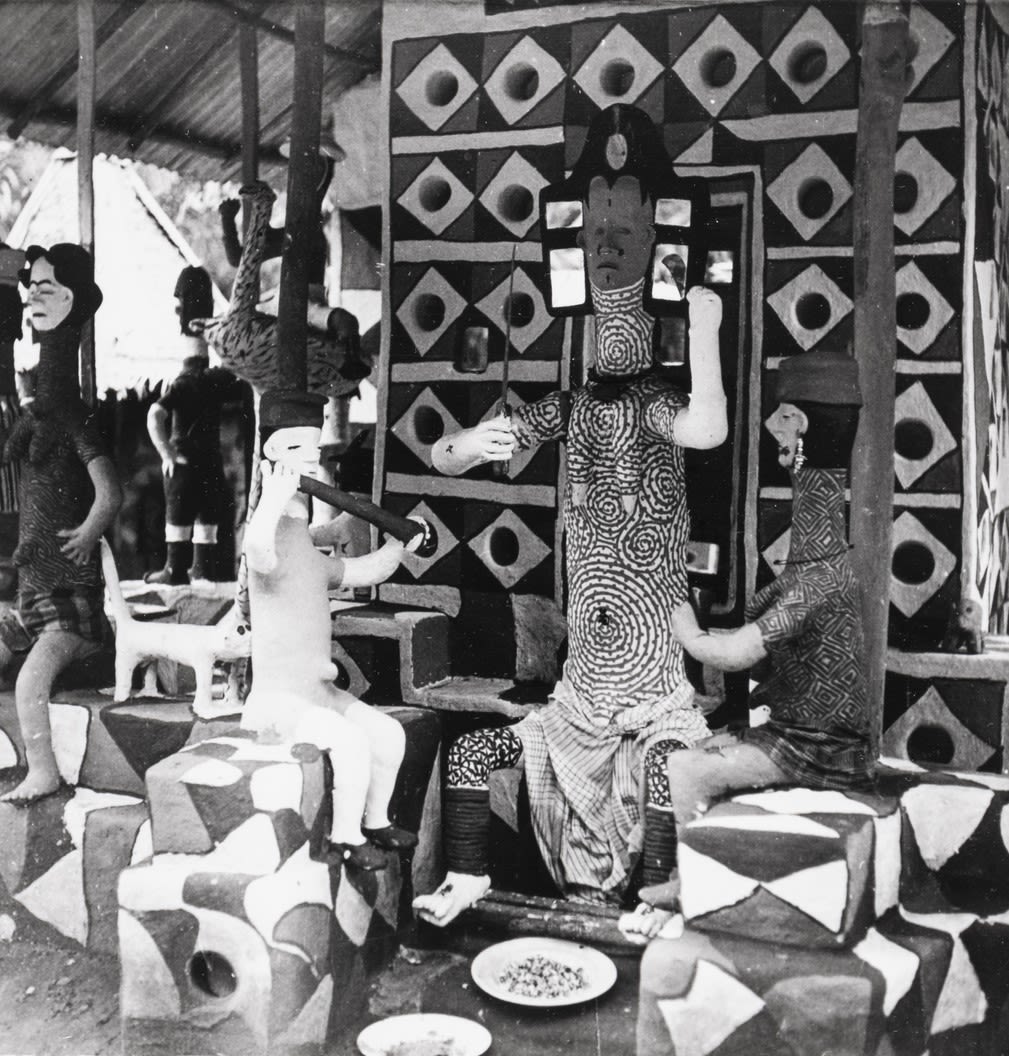
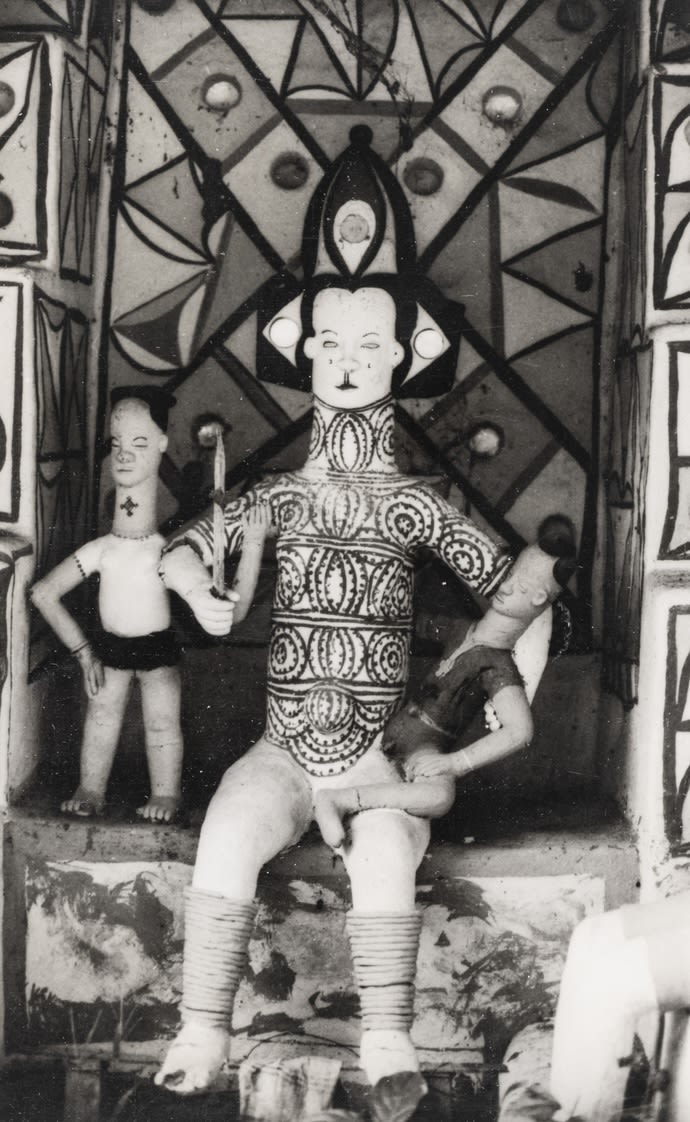
Ala, the Earth Goddess, with her attendants. Photograph by G.I. Jones. Ulakwo town, Imo, Owerri North, Nigeria. 1936. MAA P.170990.GIJ.
Ala, the Earth Goddess, with her attendants. Photograph by G.I. Jones. Ulakwo town, Imo, Owerri North, Nigeria. 1936. MAA P.170990.GIJ.

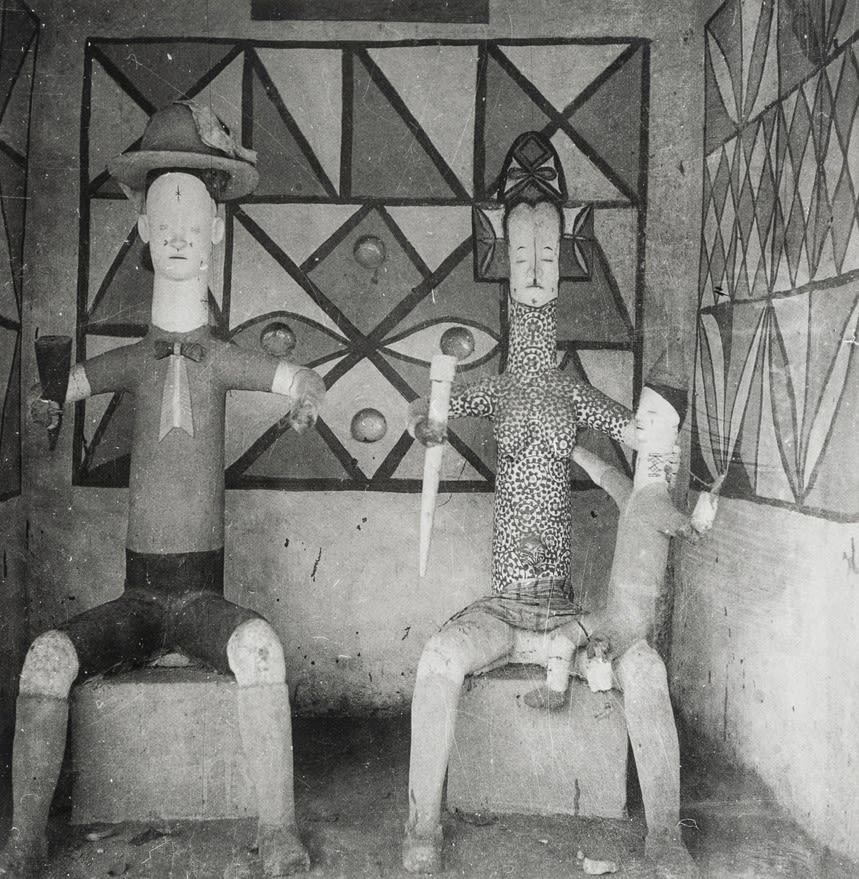
A tableau of seated clay sculptures in the alcove of an Mbari house, representing the main contributor to the building, with his wife and child. Photograph by G.I. Jones. Ulakwo town, Imo, Owerri North, Nigeria. 1936. MAA P.171066.GIJ.
A tableau of seated clay sculptures in the alcove of an Mbari house, representing the main contributor to the building, with his wife and child. Photograph by G.I. Jones. Ulakwo town, Imo, Owerri North, Nigeria. 1936. MAA P.171066.GIJ.
Mbari represents a communal sacrifice. The word Mbari means “the town eats.” Every stage of the process – from the decision to build, through construction, to the unveiling – is marked by ritual, sacrifice, and the sharing of food. It takes years to complete and will happen only once during the period in which a village occupies its current site. Building an Mbari brings prestige and symbolises the strength of the community and its shared ancestry.
The 1930s were difficult years. Economic pressures were intense, money was tight, and people’s values and priorities were changing as colonial administration, Christian missionaries, and formal education increasingly shaped everyday life. This period nevertheless marked the heyday of Mbari house building, which developed particularly in the Owerri district, the heartland of the Igbo people, perhaps in response to these pressures.
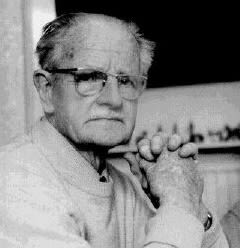
Mbari houses have not been built since the 1960s, and there is little trace of them today. Owerri suffered greatly during the civil war. Times have changed, and so have social horizons. In seeing the Mbari houses of the 1930s in these images of Ulakwo, Umowa, and other Igbo villages, we are fortunate to be following in the footsteps of Gwilliam Iwan, or “G. I.,” Jones, who was the colonial District Officer at the time. Jones later became a lecturer in Social Anthropology at Cambridge. He had deep empathy for Igbo people and their culture, and a strong passion for their performing arts and sculpture.
The 1920s and 1930s were a period when masquerades and other cultural practices were beginning to fall away, and Jones was keen to record as much as possible before they disappeared. He taught himself to use a Rolleiflex camera, aware that sending film back to England took many days and that the film used at the time easily deteriorated because of its composition and the effects of the climate. As a result, negatives and prints were often spoiled. He therefore worked out how to develop film himself in the field.
In the evenings, wherever he was staying during his travels around the district, he would hang a lamp on the veranda to distract insects, cover the windows with transparent yellow or red paper, charge his travelling torch, use three soup plates for hardener, developer, and fixer, and his camp bath for washing water. Once he had washed the films, he hung them up to dry, preventing lizards and ants from eating them, and flies and gnats from becoming stuck on them.

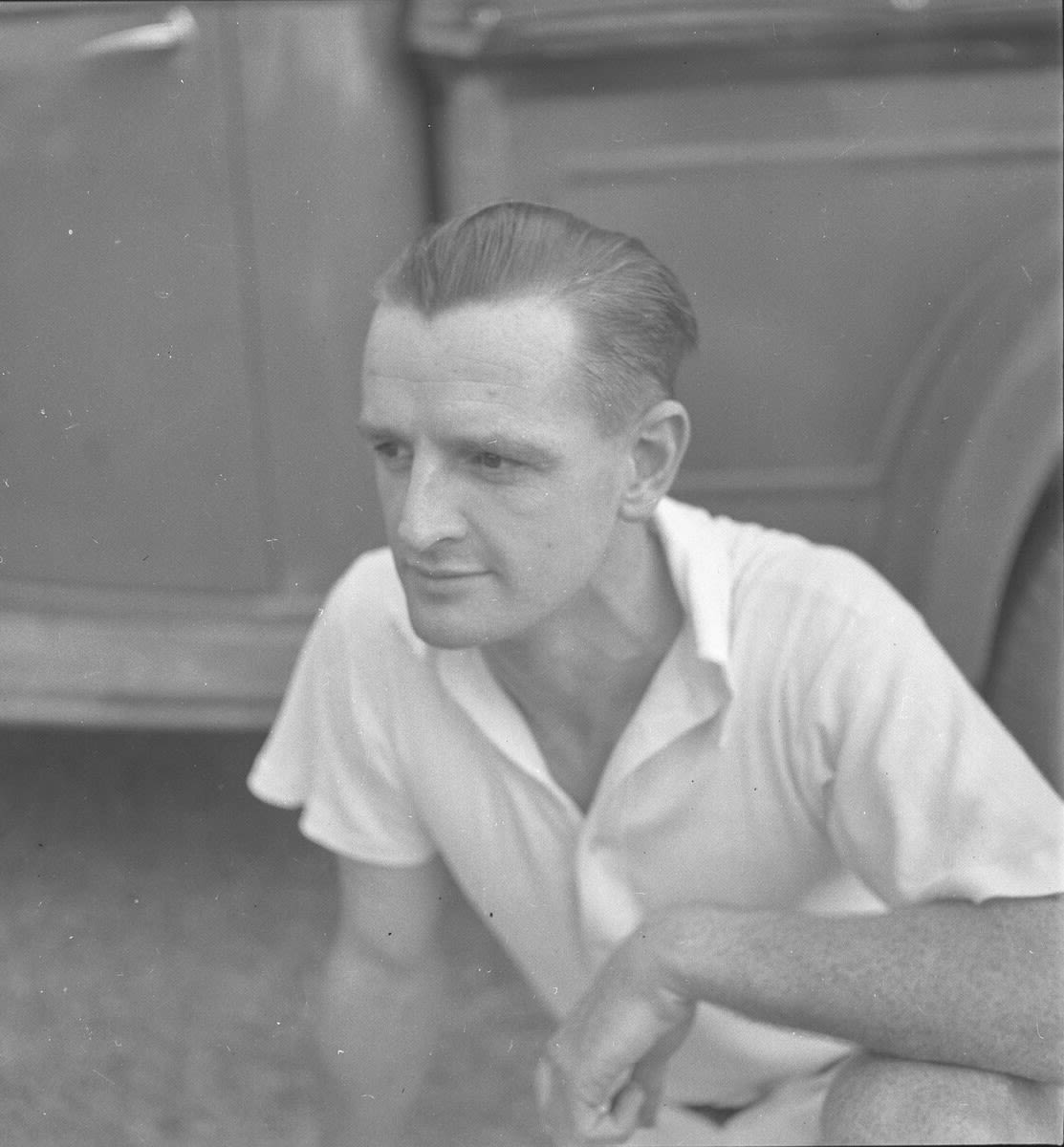
Over the last two years, I have had the privilege of helping to catalogue some of the thousands of images left by Jones to MAA. The quality of the material is outstanding, from the pristine condition of the negatives to the vivid clarity of the images. There are several hundred photographs of Mbari houses and sculptures.
I knew nothing about Mbari before encountering these photographs, and through the eyes and lens of Jones it has been a journey of discovery for me. So, with Jones as our guide, let us explore Mbari – and keep to the present tense, as if it were 1936 again.
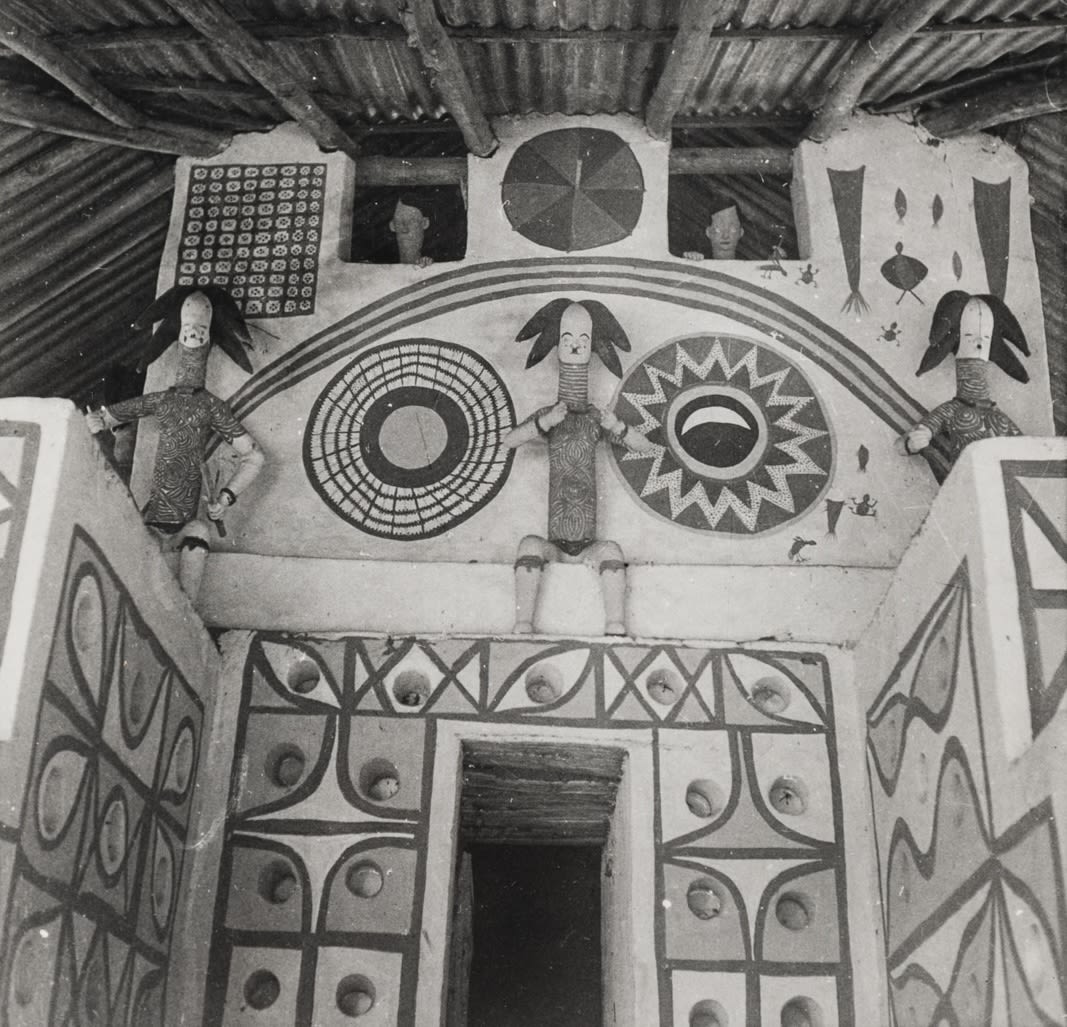
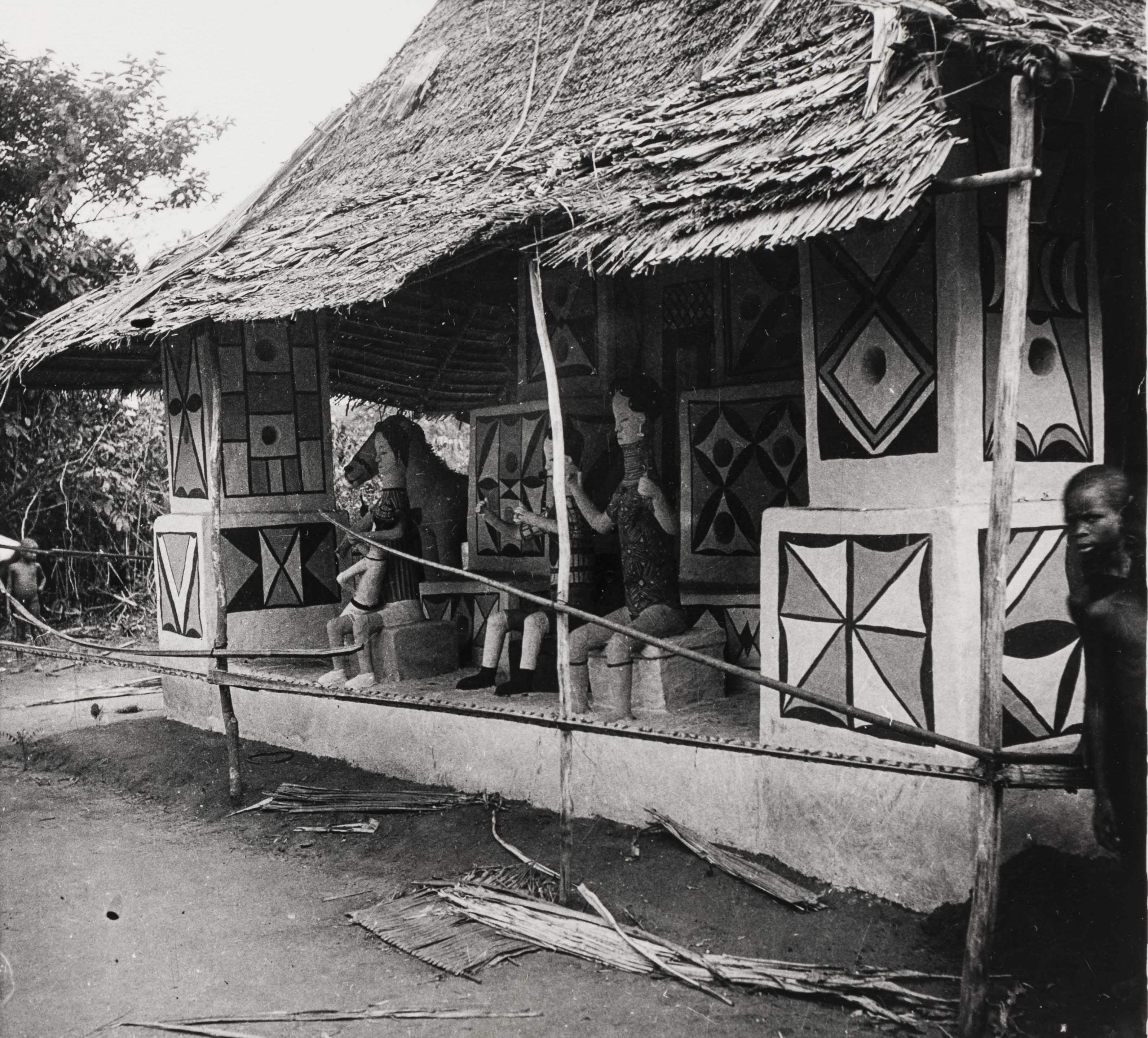
Houses vary in size and detailed design but conform to certain conventions. Each is a square or rectangular building with a pitched roof, and an inner chamber with stepped buttresses and small windows, in which the wealth of the deity is stored, such as iron rods, skulls, and clothes.
Side galleries of an Mbari house, containing various clay sculptures including a diviner (doctor) standing, and on either side a seated woman with raised arms. Photograph by G.I. Jones. Umundoche, Ngor, Owerri, Imo State, Nigeria. 1936. MAA P.170781.GIJ.
The building has solid clay pillars at the corners supporting the roof, connected by a low clay wall that encloses a deep, open veranda.
The veranda is lined with a gallery of full- and half-life-size clay sculptures, either single figures or arranged in tableaux.
Within these conventions, each Mbari house takes shape.

How is the Mbari created?
According to Herbert M. Cole, a historian of art and architecture, when the decision is made to build an Mbari house, all the families of the village agree to subscribe. They contribute manpower, animals, and money towards the cost of construction. A professional Mbari artist (ndioka) from the district is recruited to design and plan the house, direct its construction, and supervise the production of the sculpted figures, tableaux, and other artwork. He must be a master craftsman with flair and imagination, capable of delivering something special.

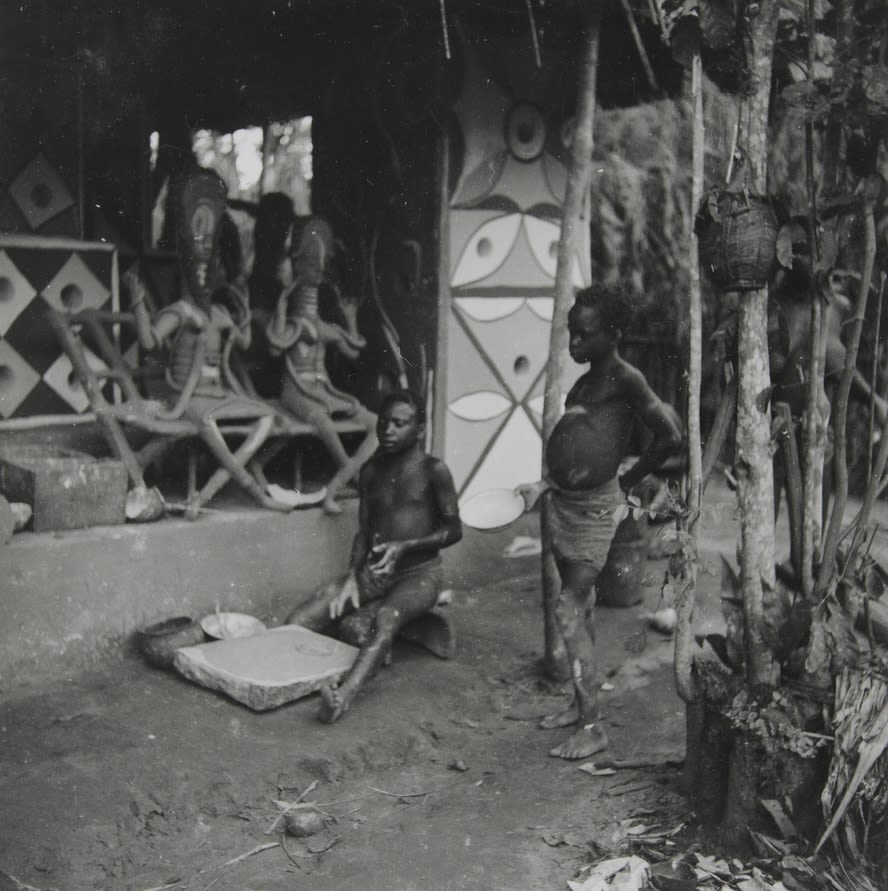
Each compound selects young people to enter the fenced Mbari enclosure for the duration of the building work, which may last several months. These ndimgbe enjoy a special status, leaving their normal lives behind, adopting new names, and conforming to the rules of the sacred enclosure. In secret, they gather the special anthill clay used for the sculptures, metaphorically described as “harvesting the yam.”
Working under the artist’s direction, they pound the clay until it becomes a smooth paste and paint the surfaces of the building and sculptures. There are also “four-day workers” who carry out the groundwork, digging laterite mud for the basic structure and erecting the walls and roof.
Rituals are carried out to reinforce the structure spiritually. For example, china soup and dinner plates are inserted into the walls to provide the deity with “eyes on the road.” The first figure to be modelled is deliberately rough and ready and is known as “the ugly person, child of the bad mortar.” This figure is thrown away and destroyed at the opening of the house; its purpose is to ward off evil.

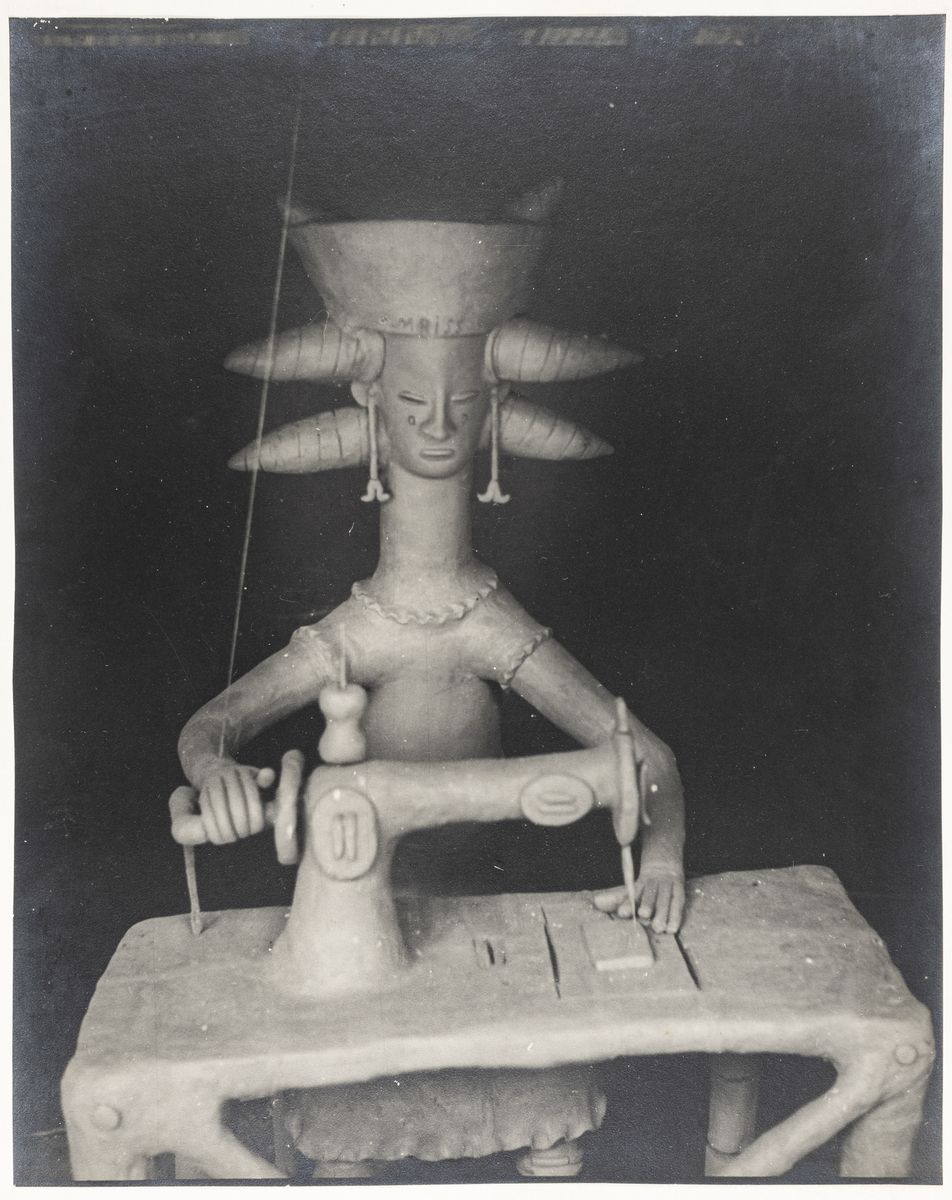
An unfinished sculpture of a woman at a treadle sewing machine. Photograph by G.I. Jones. Umundoche town, Ngor, Owerri West, Nigeria. 1936. MAA P.171040.GIJ.
An unfinished sculpture of a woman at a treadle sewing machine. Photograph by G.I. Jones. Umundoche town, Ngor, Owerri West, Nigeria. 1936. MAA P.171040.GIJ.

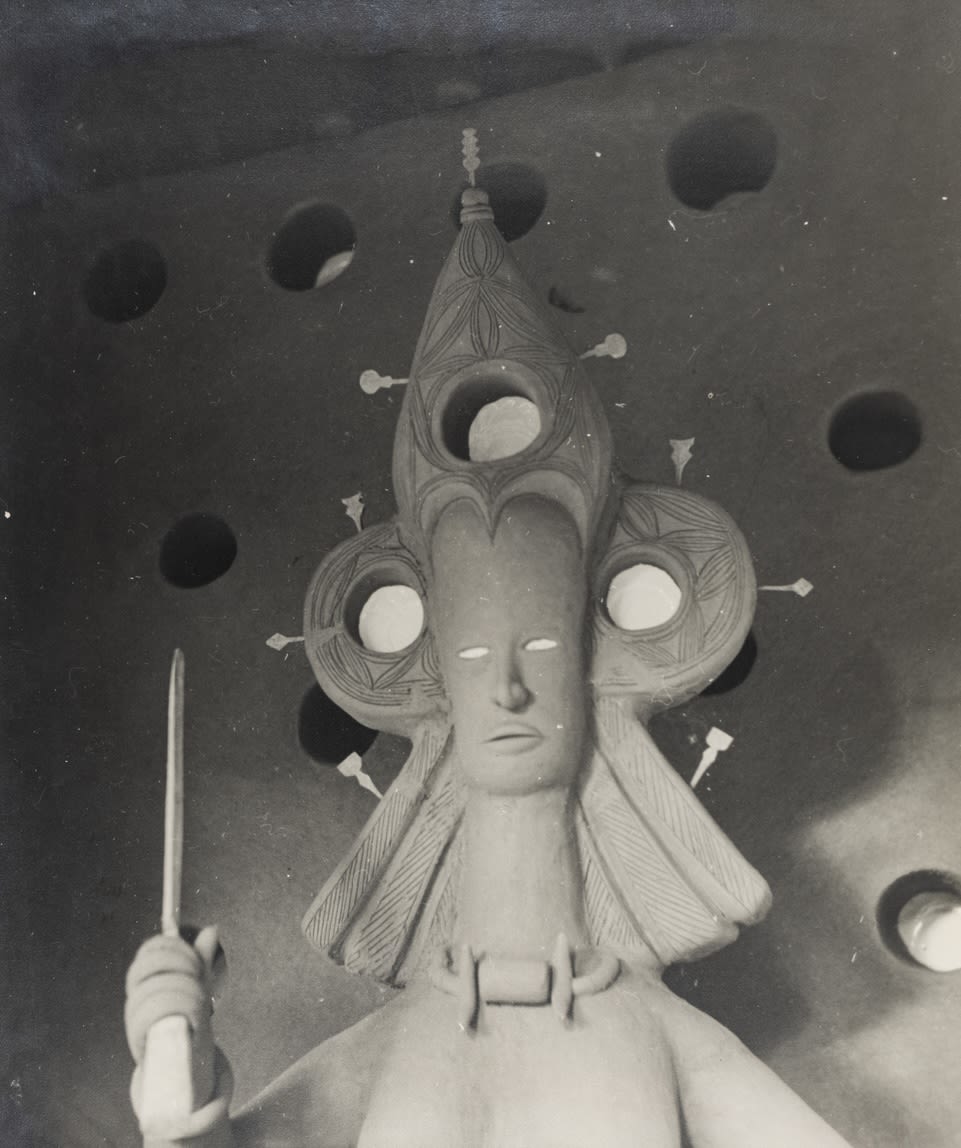
An unfinished figure of the female deity Ala. Photograph by G.I. Jones. Umundoche town, Ngor, Owerri West, Nigeria. 1936. MAA P.171036.GIJ.
An unfinished figure of the female deity Ala. Photograph by G.I. Jones. Umundoche town, Ngor, Owerri West, Nigeria. 1936. MAA P.171036.GIJ.
In discussion with the village priest, the artist works out the cast of the many figures, sculptures, and tableaux within the house, as well as its overall layout. Mbari figures have a dramatic and expressive appearance, characterised by long necks and limbs and flexed joints. For each figure, the artist creates an armature of sticks and cane, onto which he presses the clay before shaping, smoothing, and polishing it as it dries.

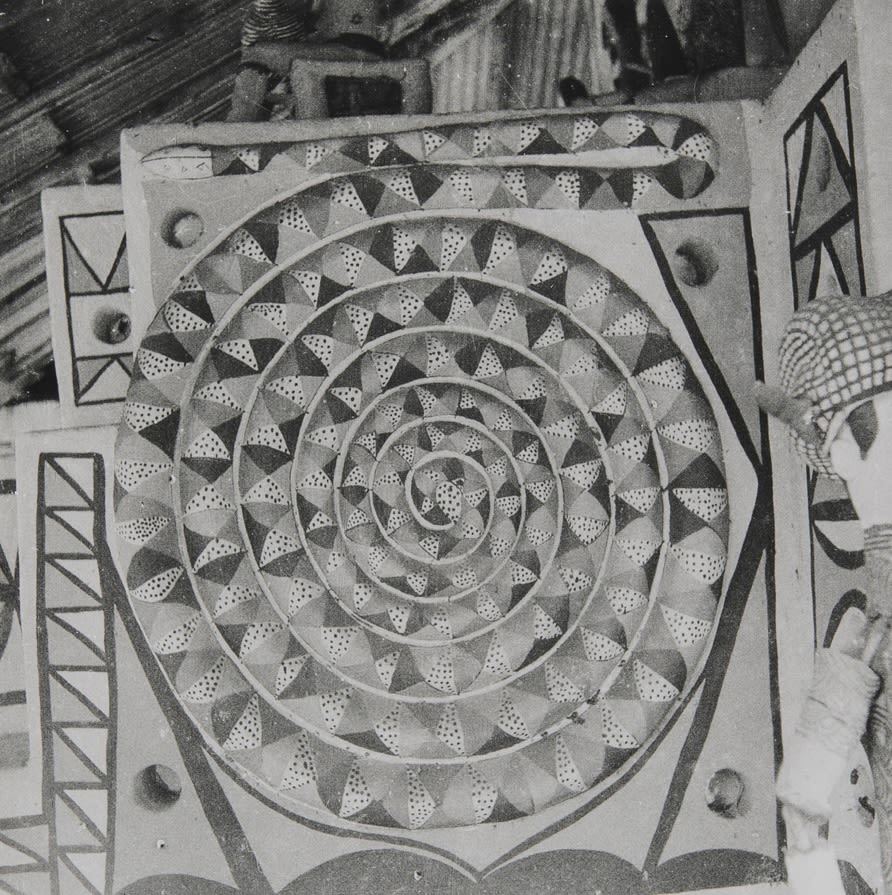

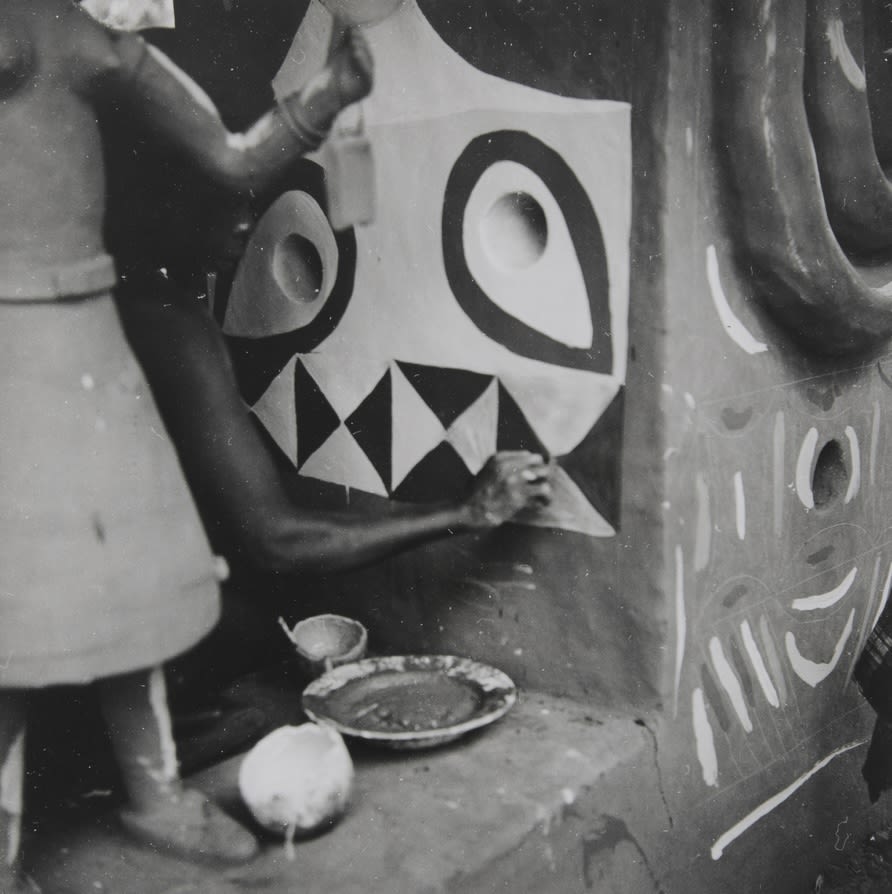
Jones’ photographs are in black and white, but in reality Mbari houses are rendered in dazzling colour. Using paintbrushes made from feathers and coconut ruff, the ndimgbe first coat the figures and the surfaces of the house with whitewash.
The bodies of the figures are then painted white, with intricate patterns in black and red, while black, red, yellow, grey, and blue are used for clothing and accessories. Cream, yellow, pink, and maroon are typical colours for the walls and buttresses.
Jones’ photographs nevertheless allow us to discern the myriad geometric forms and freehand paintings on the upper walls, depicting a wide range of subjects such as bells, umbrellas, rainbows, serpents, suns, and moons.
The artist directs the painting and brings a distinct personal style to both sculpture and decoration. He corrects and reworks elements throughout the process to ensure that his ideas are fully realised. He is attentive to the eventual spectators and their critical appreciation; for example, the figure of the deity who owns the house must look the part.

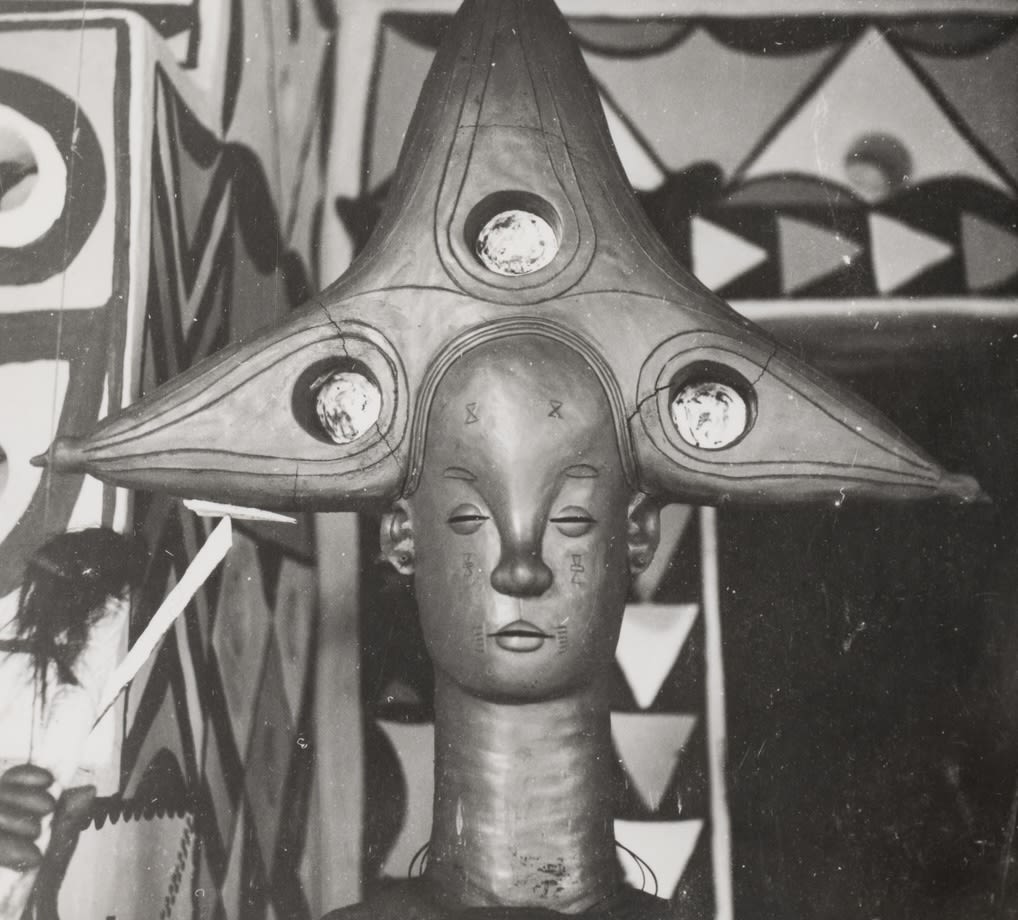
Close-up of the head of a clay sculpture depicting the female deity Ala in an unfinished Mbari house. She has a three-horned coiffure, closed eyes and mouth, and a broad nose. Photograph by G.I. Jones. Umundoche town, Ngor, Owerri West, Nigeria. 1936. MAA P.171799.GIJ.
Close-up of the head of a clay sculpture depicting the female deity Ala in an unfinished Mbari house. She has a three-horned coiffure, closed eyes and mouth, and a broad nose. Photograph by G.I. Jones. Umundoche town, Ngor, Owerri West, Nigeria. 1936. MAA P.171799.GIJ.

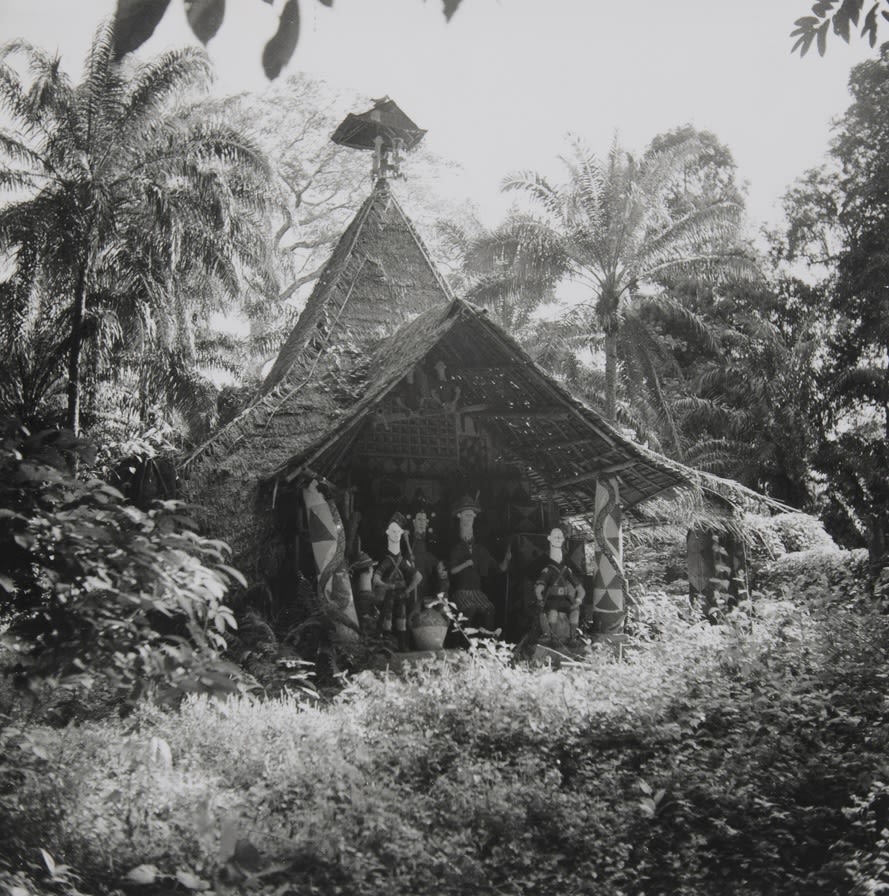
An old Mbari house set among trees and lush vegetation. Photograph by G.I. Jones. Irette village, Ihiagwa area, Nekede town, Owerri West, Nigeria. 1936. MAA P.170750.GIJ.
An old Mbari house set among trees and lush vegetation. Photograph by G.I. Jones. Irette village, Ihiagwa area, Nekede town, Owerri West, Nigeria. 1936. MAA P.170750.GIJ.
When everything is ready, a sacrifice is made in the evening to symbolise the completion of the house and to mark its dedication to the deity. The “first figure,” along with the fences, the enclosure door, and the brushes and materials, is thrown into a pit and burned. A further sacrifice is then performed to purify the workers and the artist, after which everyone involved in building the house celebrates with music, fire, and food. It is, in effect, a housewarming party to welcome the deity into their new home and to ensure they feel happy and comfortable. The ndimgbe then return, as if reborn, to their normal lives with their families in their compounds.

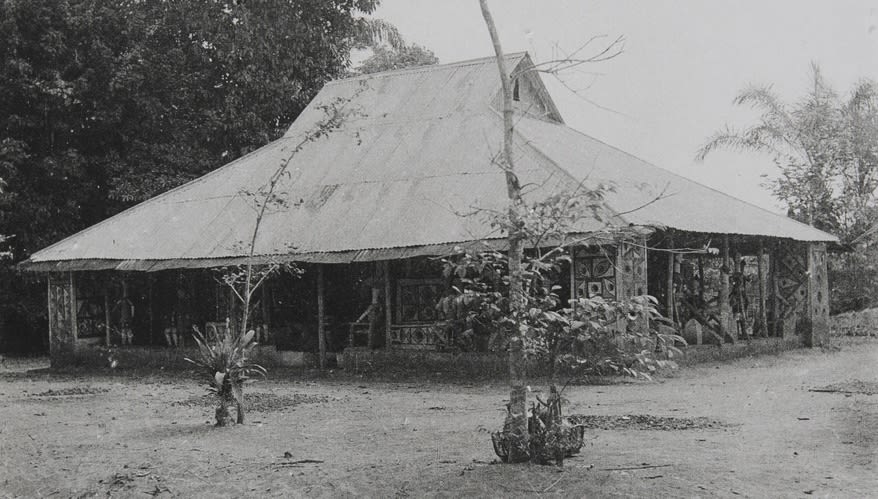
A large Mbari house in Ulakwo town, Owerri North, Nigeria. Photograph by G.I. Jones. 1936. MAA P.170755.GIJ.
A large Mbari house in Ulakwo town, Owerri North, Nigeria. Photograph by G.I. Jones. 1936. MAA P.170755.GIJ.
The public opening of the house takes place the following morning. People from the village and neighbouring settlements crowd around to marvel at the Mbari, viewing the figures with wonder, excitement, and joy. The house is rich in metaphor and meaning, telling stories and evoking emotions. It is a puzzle, a spectacle, and a form of entertainment. Yet no one may enter the house: it belongs to the deity, who looks out, while the people look in.

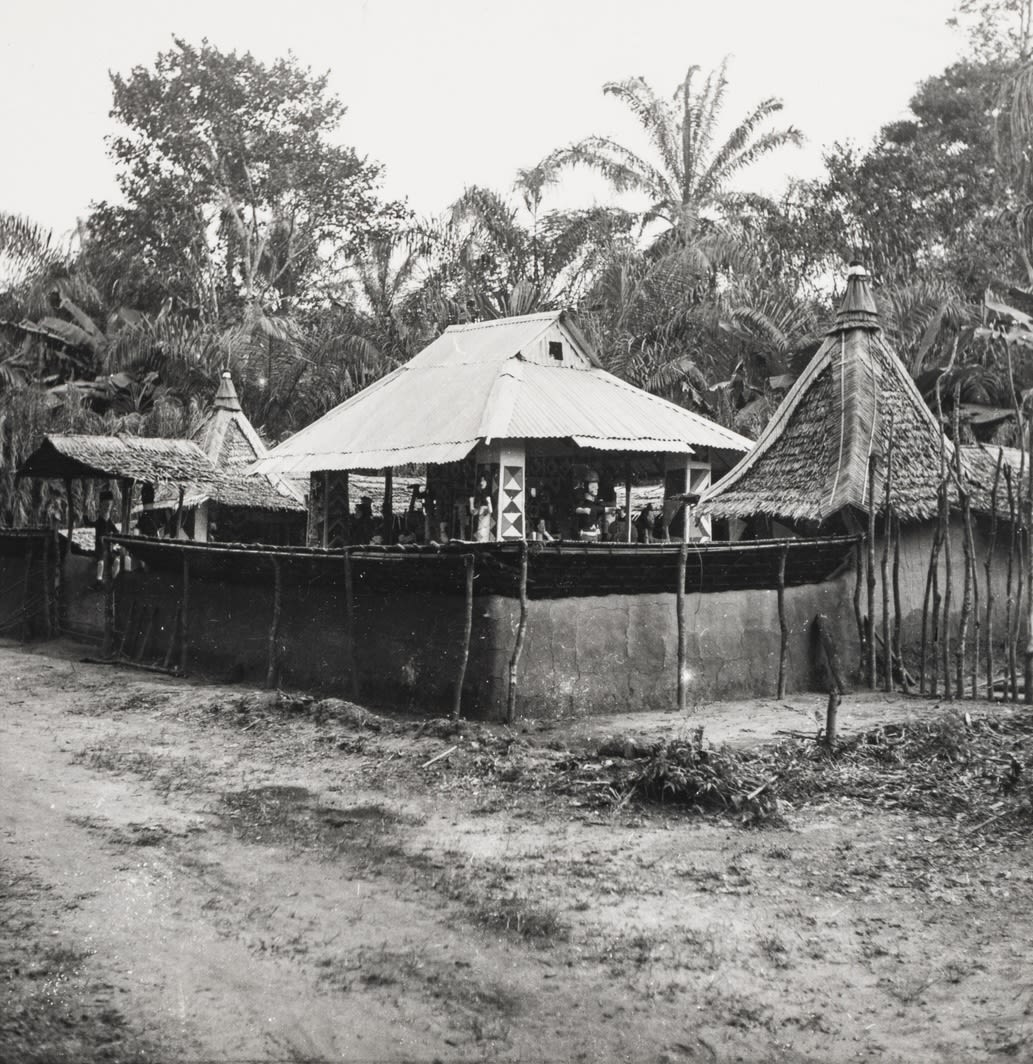
An Mbari house standing within an enclosed compound. Photograph by G.I. Jones. Umuhu Ngor, Imo State, Nigeria. 1936. MAA P.171052.GIJ.
An Mbari house standing within an enclosed compound. Photograph by G.I. Jones. Umuhu Ngor, Imo State, Nigeria. 1936. MAA P.171052.GIJ.
The house is the product of the Mbari sacrifice, and the process of designing and realising it is dynamic. It takes many twists and turns as the outcomes of sacrifices are divined, and as the priest and artist develop the design along the way. Relatively few of Jones’ images document this process, which may reflect issues of timing and opportunity. The houses at Umowa and Ulakwo had just been completed and were already on public display. However, Jones also photographed work underway on Mbari houses at Umuhu Ngor and Umundoche, as well as older Mbari houses in various states of decay, such as the example at Ihiagwa.
A Gallery of Sculptures
The sculptures bring Mbari to life. They range from idealised representations of gods, spirits, and animals to scenes drawn from everyday life and contemporary experience. The galleries of individual figures and tableaux are arranged to guide viewers from scene to scene: one moment admiring the dignity of the owner deity, the next recognising episodes drawn from proverbs and moral stories, and then laughing at comic characters or bawdy scenes.
Some figures and scenes are familiar “stock” characters, while others are newly invented. This interplay between familiarity and surprise is central to the spectacle, engaging spectators in an experience that is at once intensely cognitive and deeply emotional.


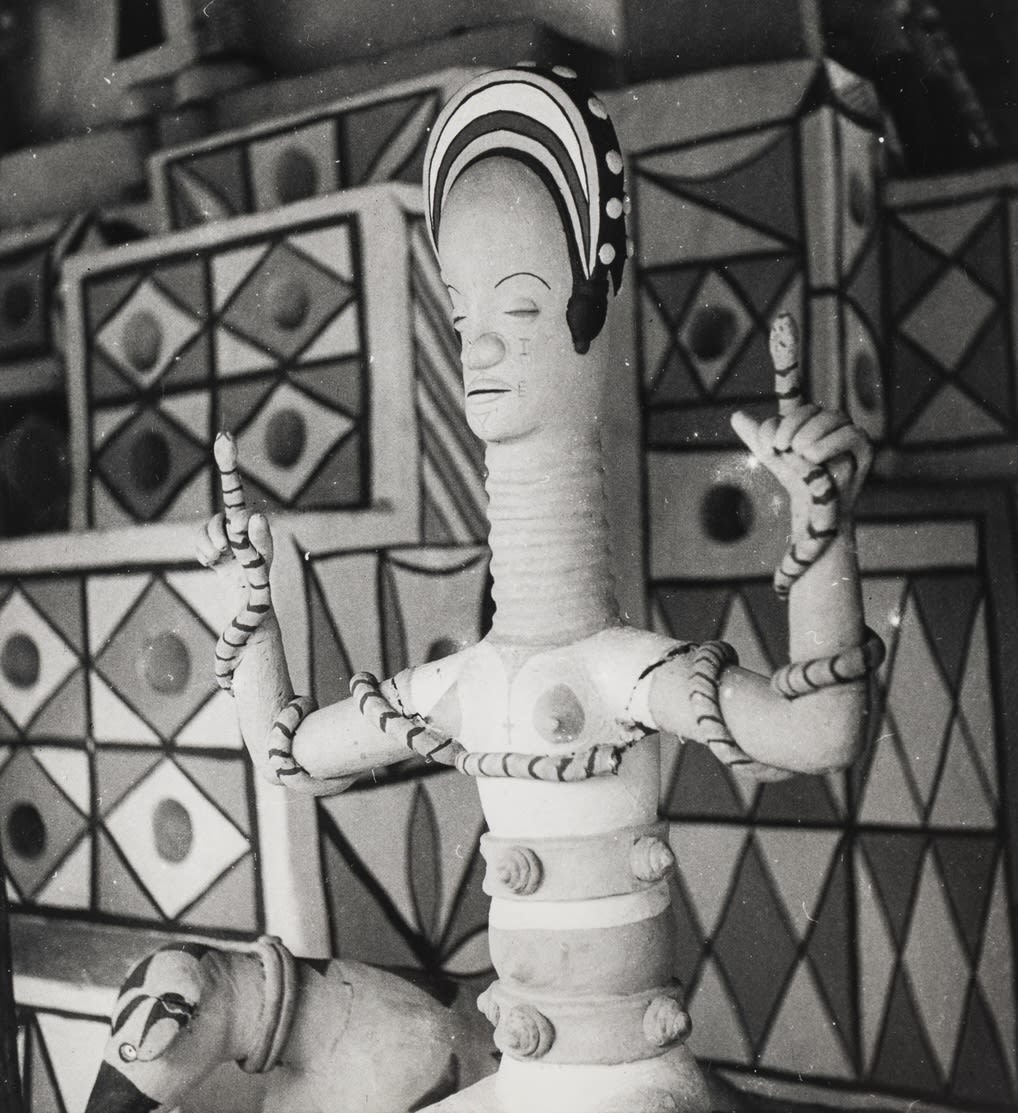














The cult spirit Mammywater, associated with wealth, depicted with snakes coiled around her torso and arms. Photograph by G.I. Jones. Umowa, Oratta, Imo State, Nigeria. 1936. MAA P.171759.GIJ.
The cult spirit Mammywater, associated with wealth, depicted with snakes coiled around her torso and arms. Photograph by G.I. Jones. Umowa, Oratta, Imo State, Nigeria. 1936. MAA P.171759.GIJ.
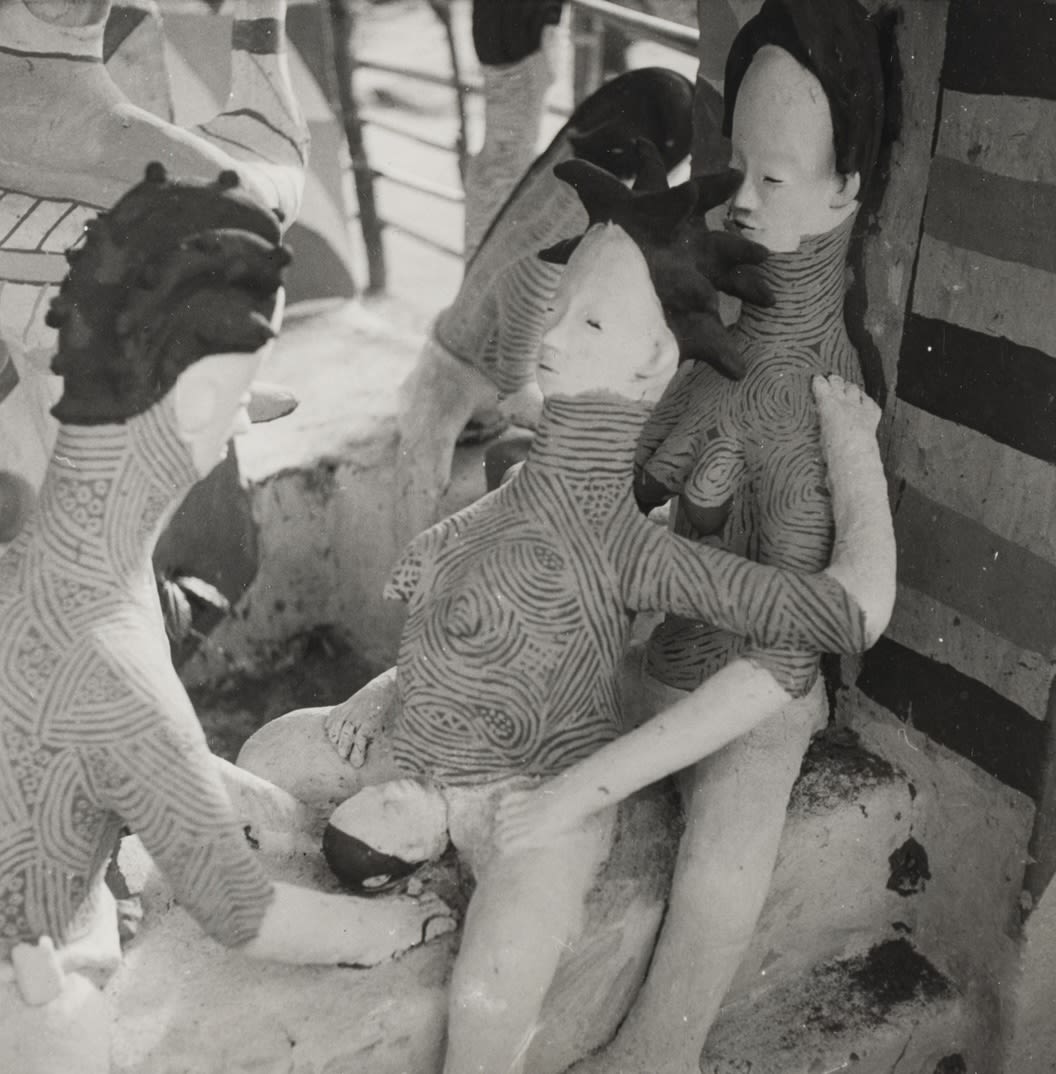
The spirit Ekunocha with her children. Photograph by G.I. Jones. Umowa, Oratta, Imo State, Nigeria. 1936. MAA P.171011.GIJ.
The spirit Ekunocha with her children. Photograph by G.I. Jones. Umowa, Oratta, Imo State, Nigeria. 1936. MAA P.171011.GIJ.
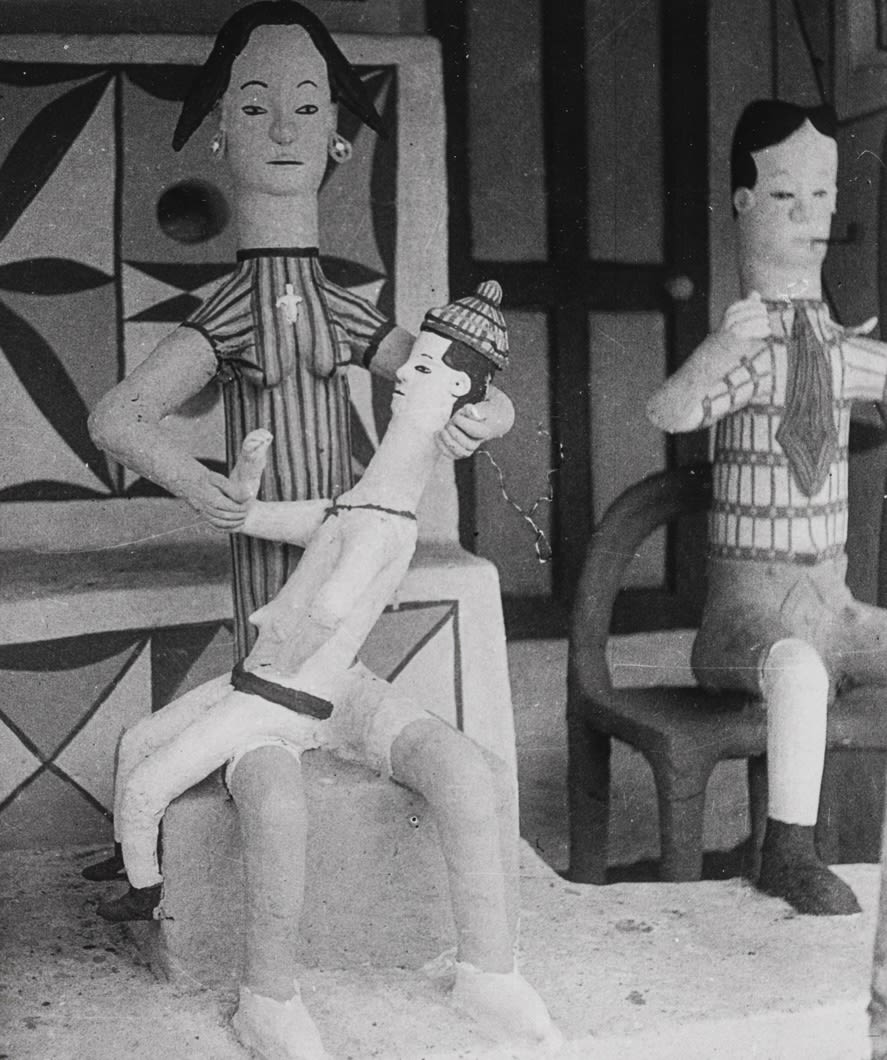
A mother figure with child and a man smoking a pipe. Photograph by G.I. Jones. Umowa, Oratta, Imo State, Nigeria. 1936. MAA P.170947.GIJ.
A mother figure with child and a man smoking a pipe. Photograph by G.I. Jones. Umowa, Oratta, Imo State, Nigeria. 1936. MAA P.170947.GIJ.
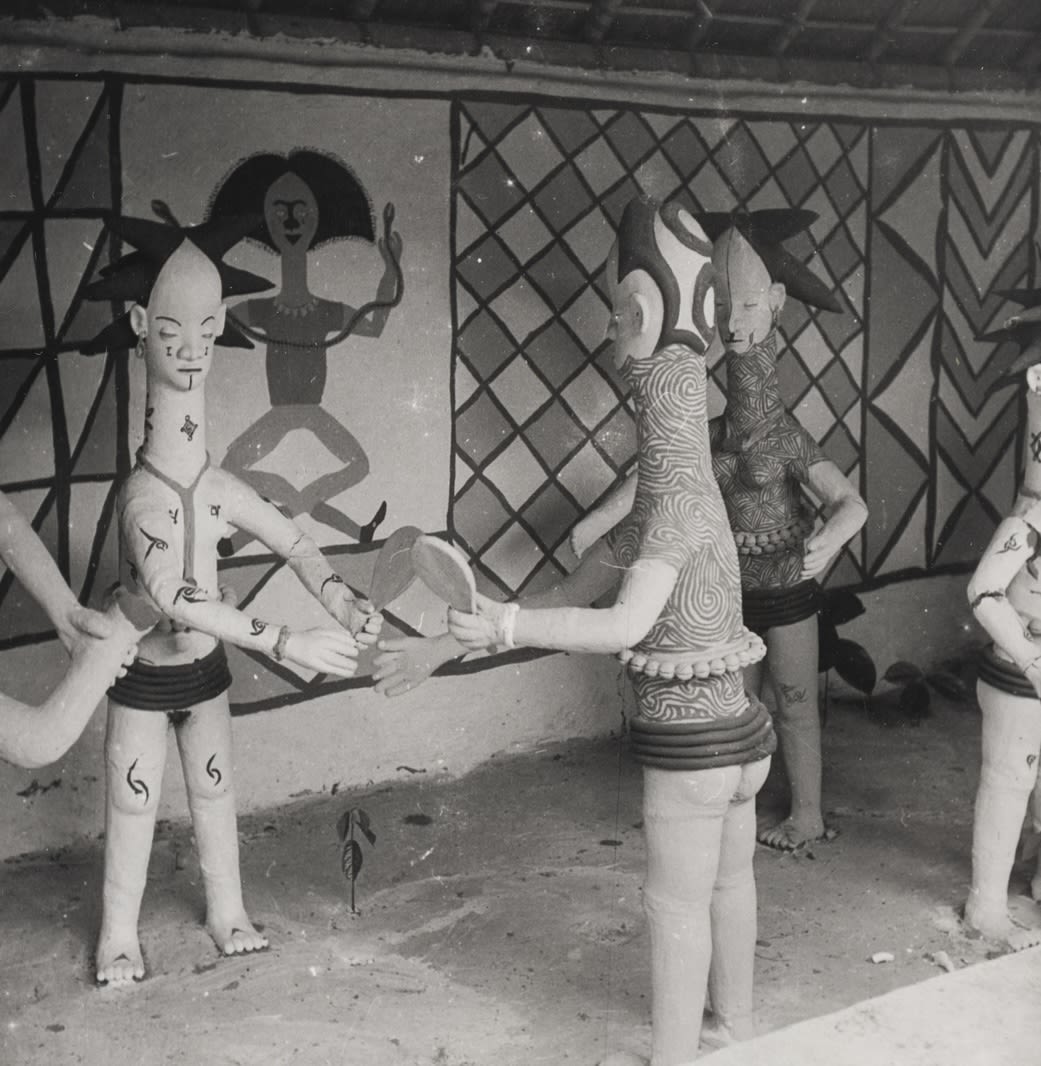
Female figures holding mirrors and adornments in their hands. Photograph by G.I. Jones. Umowa, Oratta, Imo State, Nigeria. 1936. MAA P.171769.GIJ.
Female figures holding mirrors and adornments in their hands. Photograph by G.I. Jones. Umowa, Oratta, Imo State, Nigeria. 1936. MAA P.171769.GIJ.
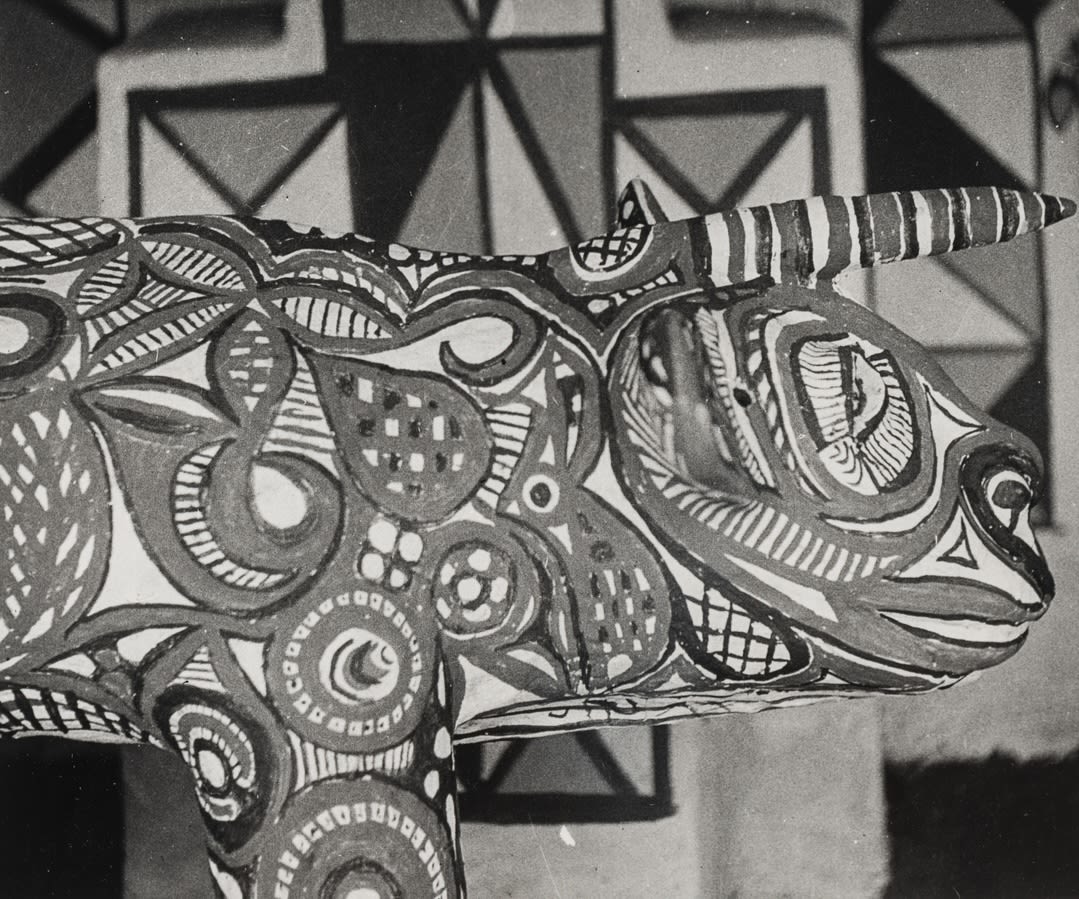
A horned animal decorated with swirling patterns. Photograph by G.I. Jones. Umowa, Oratta, Imo State, Nigeria. 1936. MAA P.171752.GIJ.
A horned animal decorated with swirling patterns. Photograph by G.I. Jones. Umowa, Oratta, Imo State, Nigeria. 1936. MAA P.171752.GIJ.
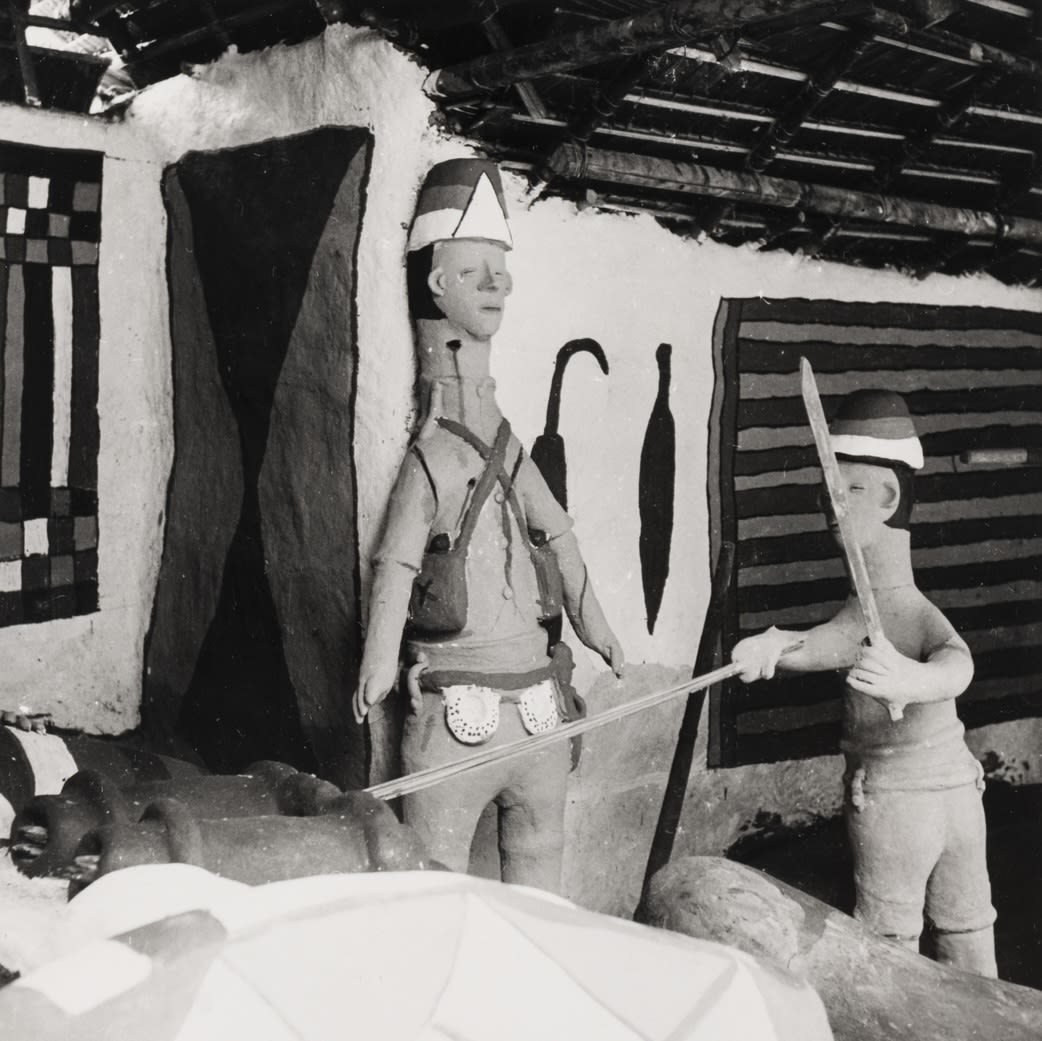
A tableau of soldiers, one wounded, and the other about to fire a canon. Photograph by G.I. Jones. Umowa, Oratta, Imo State, Nigeria. 1936. MAA P.171804.GIJ.
A tableau of soldiers, one wounded, and the other about to fire a canon. Photograph by G.I. Jones. Umowa, Oratta, Imo State, Nigeria. 1936. MAA P.171804.GIJ.
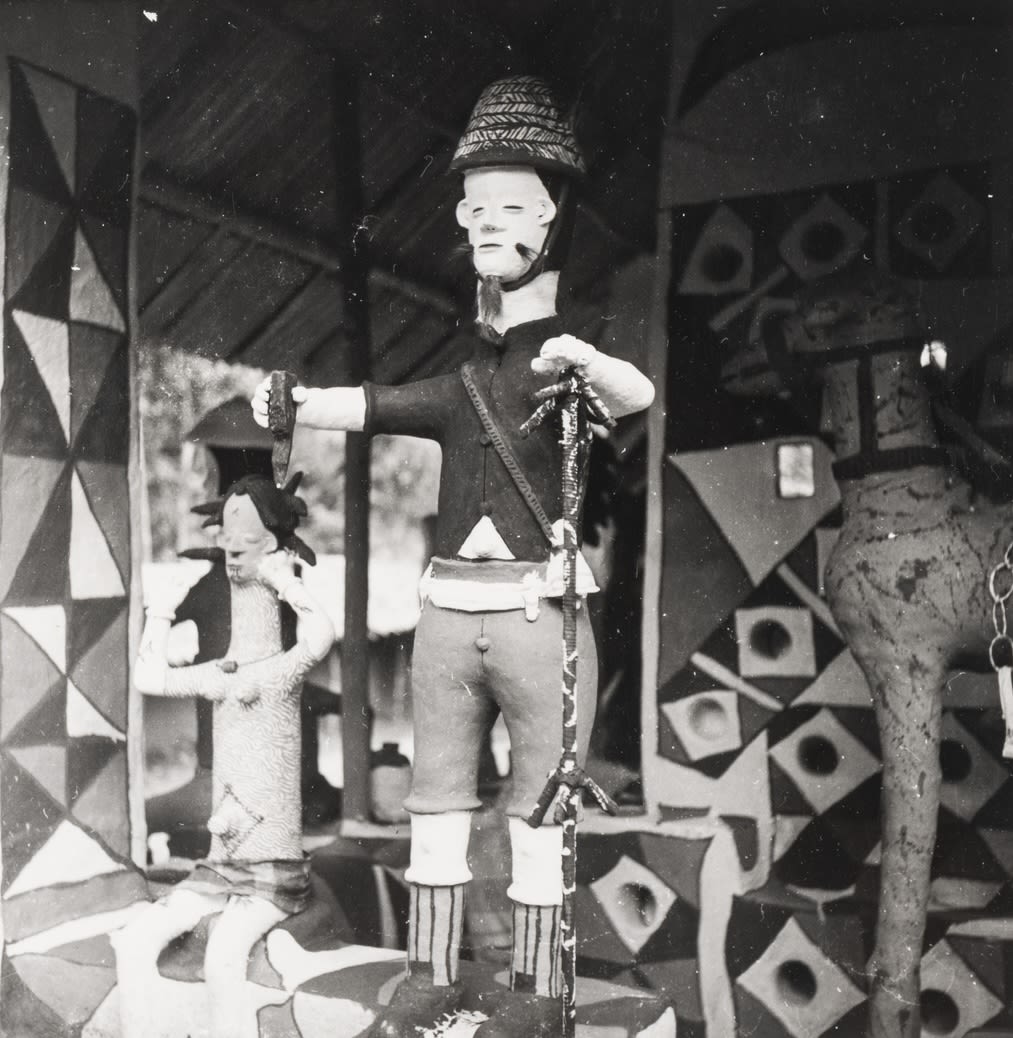
A giant policeman with a seated attendant by his side, and an elephant behind. Photograph by G.I. Jones. Umundoche, Owerri, Imo State, Nigeria. 1936. MAA P.171806.GIJ.
A giant policeman with a seated attendant by his side, and an elephant behind. Photograph by G.I. Jones. Umundoche, Owerri, Imo State, Nigeria. 1936. MAA P.171806.GIJ.
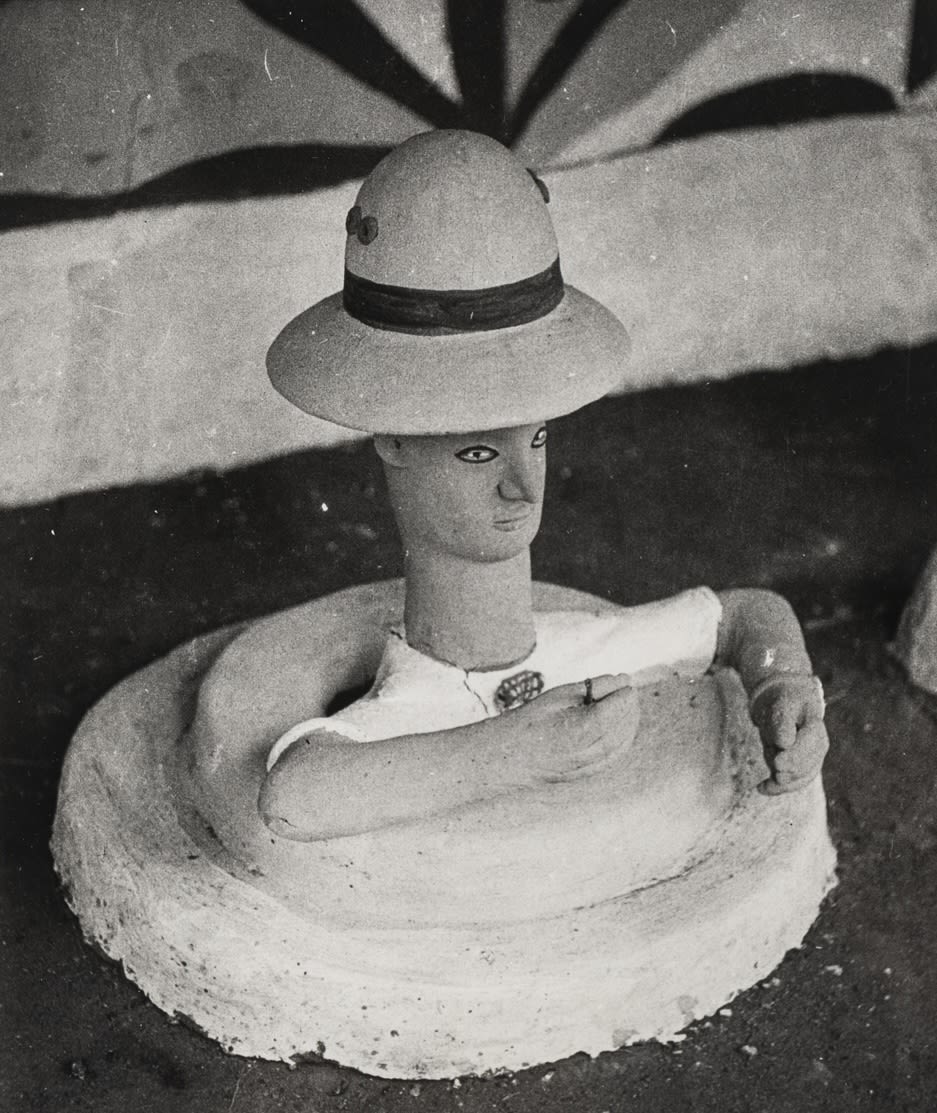
A European emerging from the ground, wearing a sun hat – illustrating a popular local story about the origins of white men. Photograph by G. I. Jones. Umowa, Oratta, Imo State, Nigeria. 1936. MAA P.171754.GIJ.
A European emerging from the ground, wearing a sun hat – illustrating a popular local story about the origins of white men. Photograph by G. I. Jones. Umowa, Oratta, Imo State, Nigeria. 1936. MAA P.171754.GIJ.
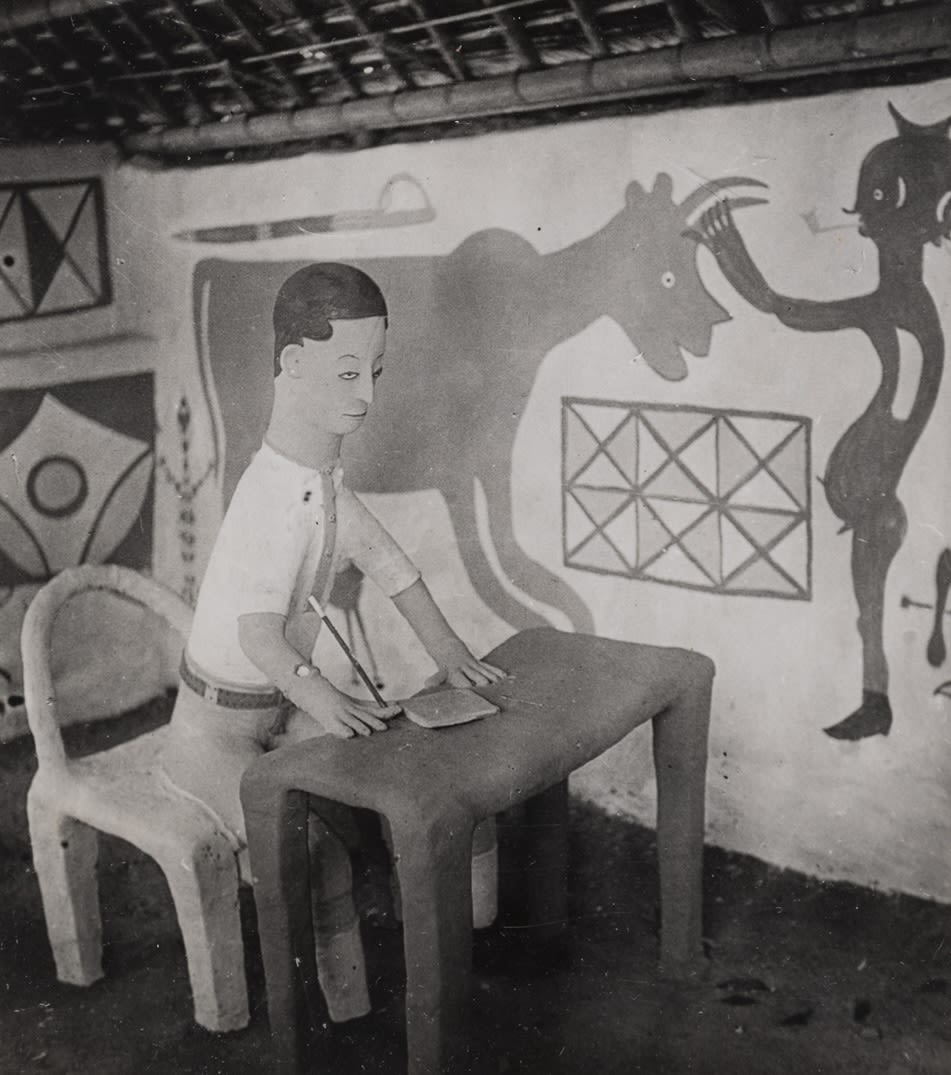
A district officer at his desk. Photograph by G. I. Jones. Umowa, Oratta, Imo State, Nigeria. 1936. MAA P.170962.GIJ.
A district officer at his desk. Photograph by G. I. Jones. Umowa, Oratta, Imo State, Nigeria. 1936. MAA P.170962.GIJ.
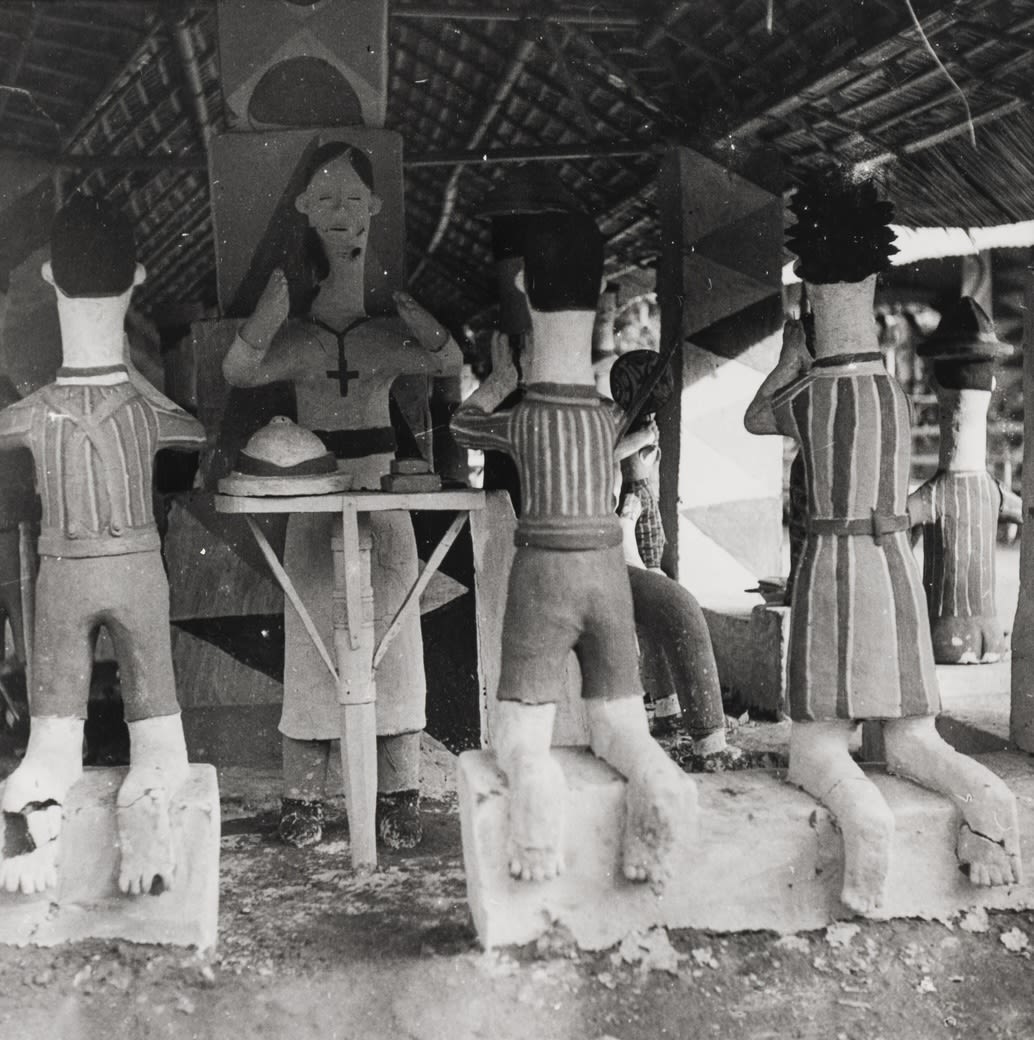
A tableau of figures representing a priest and communicants in a catholic church service. Photograph by G.I. Jones. Umowa, Oratta, Imo State, Nigeria. 1936. MAA P.171778.GIJ.
A tableau of figures representing a priest and communicants in a catholic church service. Photograph by G.I. Jones. Umowa, Oratta, Imo State, Nigeria. 1936. MAA P.171778.GIJ.
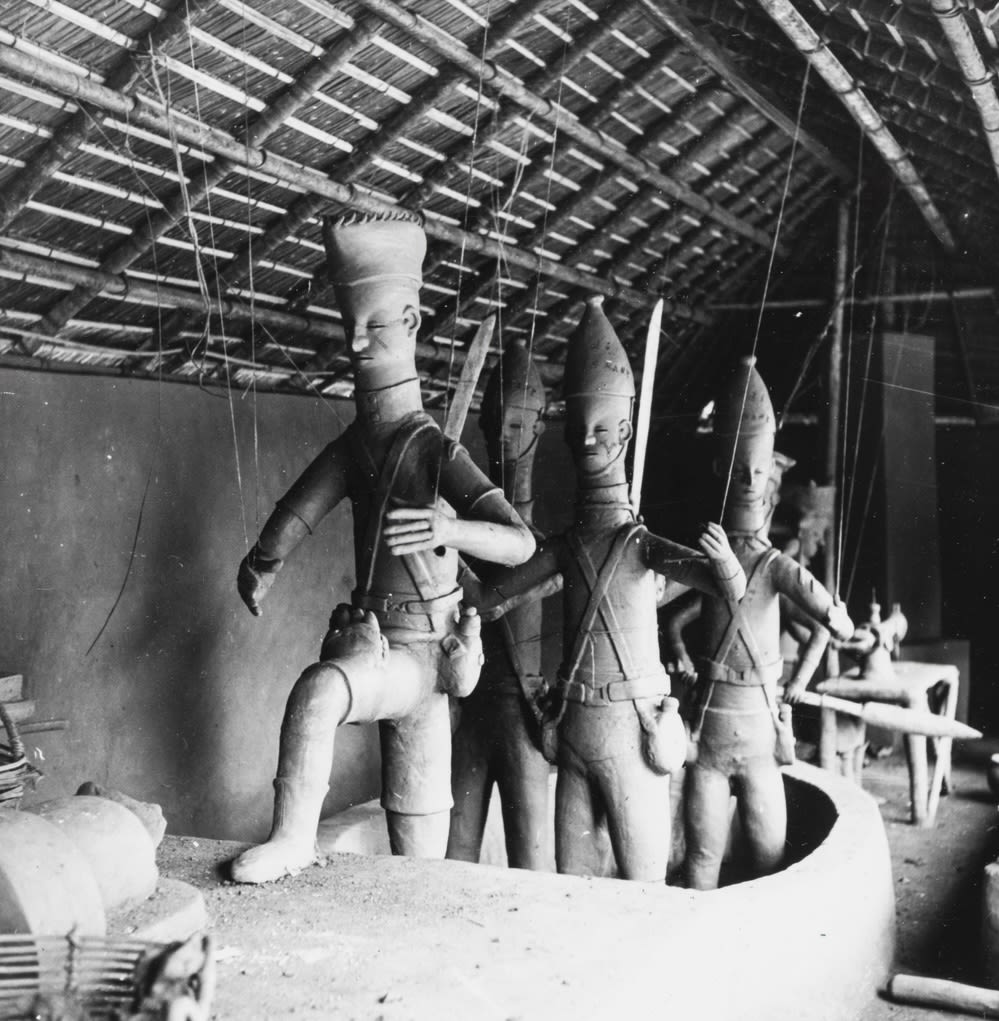
A line of soldiers disembarking from a boat during the campaign in Cameroon, 1914–18. Photograph by G.I. Jones. Umundoche, Owerri, Imo State, Nigeria. 1936. MAA P.171005.GIJ.
A line of soldiers disembarking from a boat during the campaign in Cameroon, 1914–18. Photograph by G.I. Jones. Umundoche, Owerri, Imo State, Nigeria. 1936. MAA P.171005.GIJ.
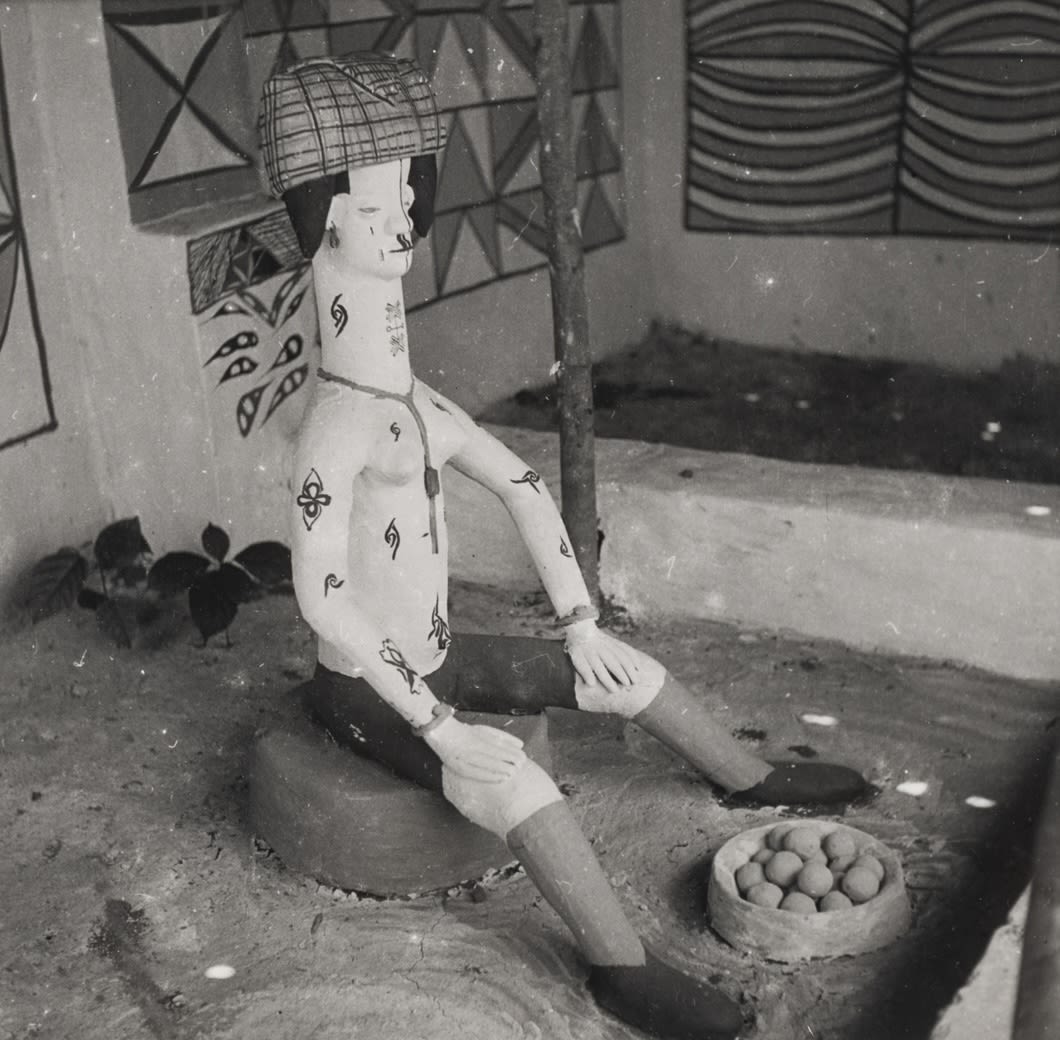
A market woman with a bowl of food. Photograph by G.I. Jones. Umowa, Oratta, Imo State, Nigeria. 1936.MAA P.171774.GIJ.
A market woman with a bowl of food. Photograph by G.I. Jones. Umowa, Oratta, Imo State, Nigeria. 1936.MAA P.171774.GIJ.
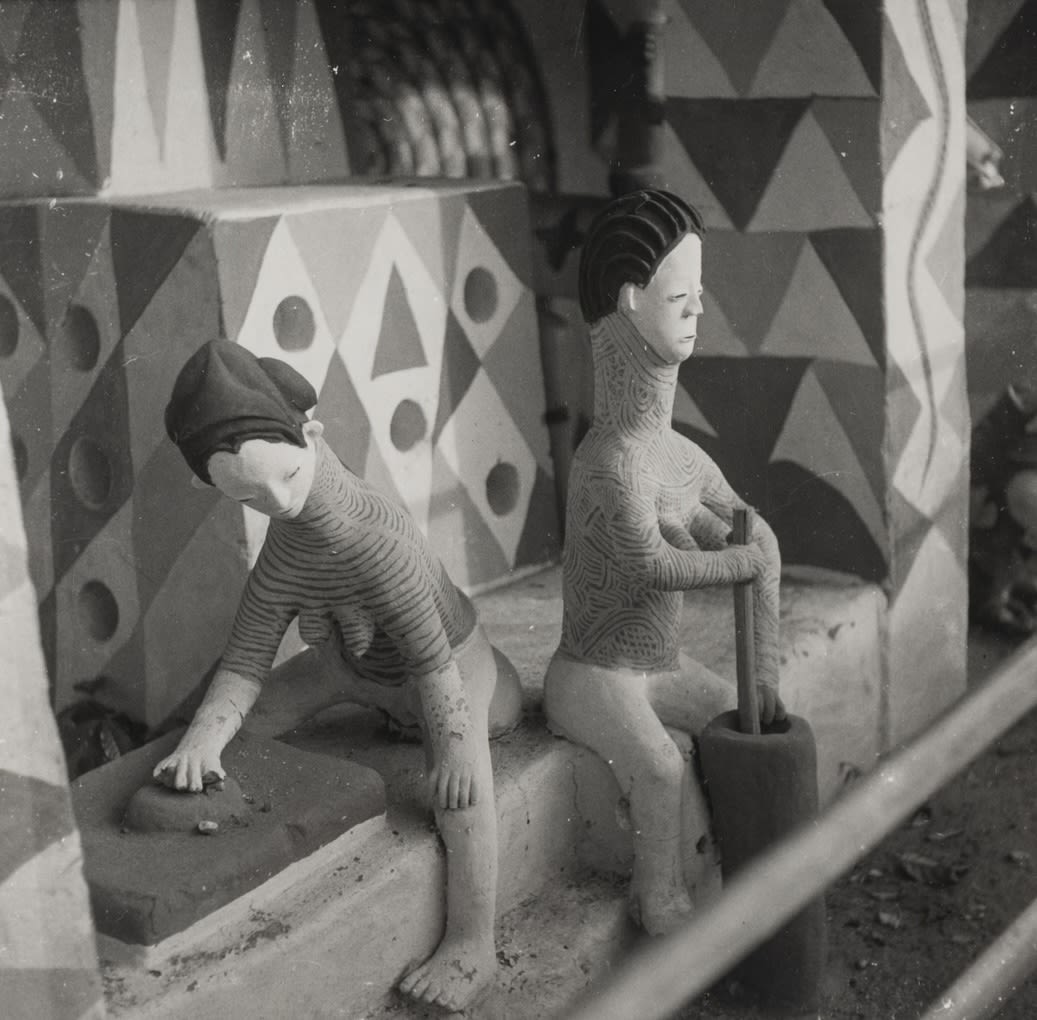
Women grinding flour and pounding grain. Photograph by G.I. Jones. Umuhu Ngor, Owerri, Imo State, Nigeria. 1936. MAA P.171746.GIJ.
Women grinding flour and pounding grain. Photograph by G.I. Jones. Umuhu Ngor, Owerri, Imo State, Nigeria. 1936. MAA P.171746.GIJ.
A woman giving birth. Photograph by G.I. Jones. Umuhu Ngor, Owerri, Imo State, Nigeria. 1936. MAA P.171744.GIJ.
A woman giving birth. Photograph by G.I. Jones. Umuhu Ngor, Owerri, Imo State, Nigeria. 1936. MAA P.171744.GIJ.
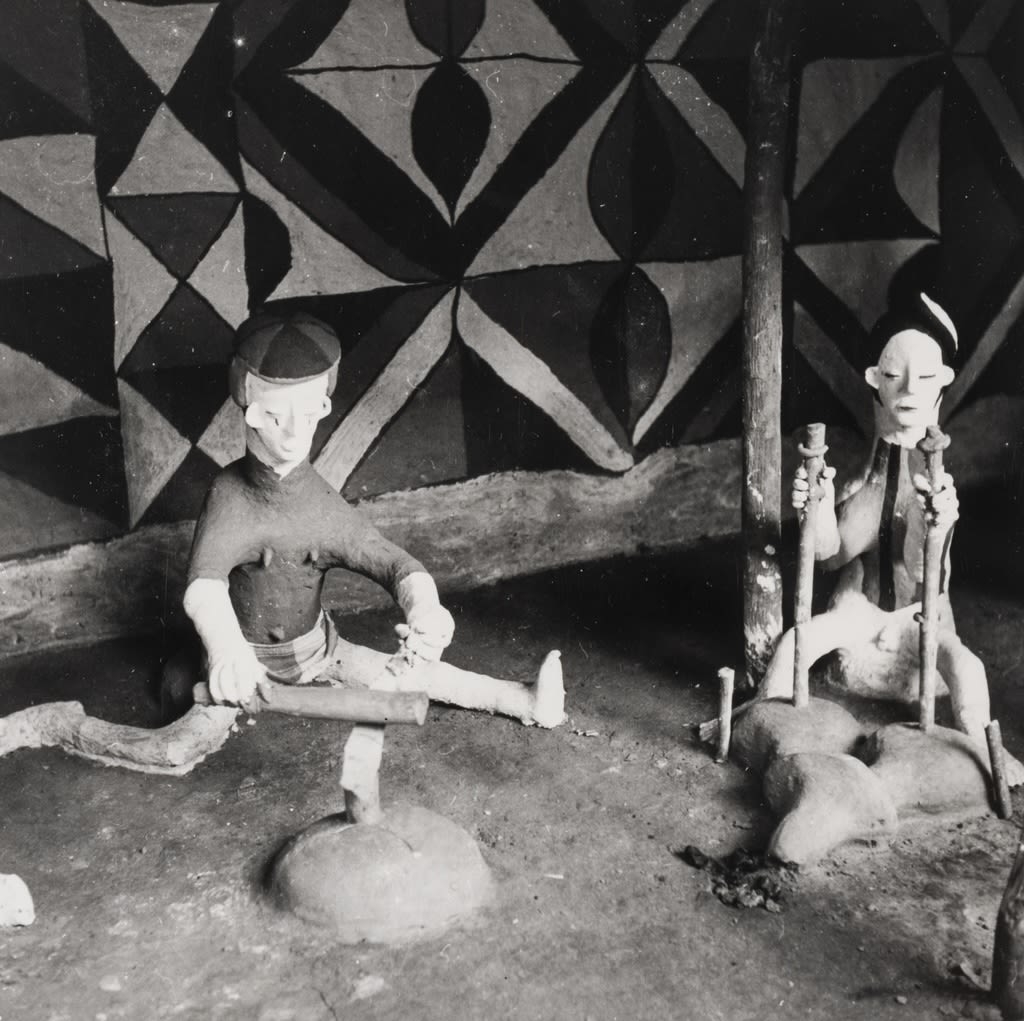
A blacksmith at work with his attendant on the bellows. Photograph by G.I. Jones. Umundoche, Owerri, Imo State, Nigeria. 1936. MAA P.171802.GIJ.
A blacksmith at work with his attendant on the bellows. Photograph by G.I. Jones. Umundoche, Owerri, Imo State, Nigeria. 1936. MAA P.171802.GIJ.
Mbari stands as a dramatic and colourful contrast to the rhythms of everyday village life. The house is a monument, but it is not a place of worship. Once it has been presented to, and accepted by, the deity, its function is complete.
When newly opened to public view, the Mbari house stands proudly in and for the village. Jones’ descriptions and explanations of Mbari are shrewd, grounded, and at times whimsical. He observed that Mbari houses:
“…combined the religious and communal enthusiasms which went into the building of medieval cathedrals of Western Europe with the naïve excitement and curiosity about the world around them that gave rise to the waxworks of Victorian London…”
Jones 1984: 82
Yet, unlike cathedrals, Mbari houses were never intended to endure, nor were they built as permanent sites of worship. As Chike Ezimora remarks, after the opening celebration, “the sacrifice is over… the important thing is the essence of sacrifice, not the object.” The Mbari house is not touched or repaired, but is left to weather, disintegrate, and eventually disappear into the forest – absorbed by nature and by the gods, spirits, and animals to whom it was first offered.
An old Mbari house set among trees. Photograph by G.I. Jones. Irette village, Ihiagwa area, Nekede town, Owerri West, Nigeria. 1936. MAA P.170748.GIJ.
‘Mbari’ Lives On
Mbari emerged from a cultural milieu shaped by village life, in which people lived off the land. Wealth was measured in terms of family size, stores of produce, numbers of livestock, personal prestige and titles, and the standing of one’s lineage and village. While this world has changed radically in many respects, the underlying worldview endures: to get on in life, people must bargain with one another and with their gods. Action is required in order to change one’s conditions.
The practice of building Mbari houses has disappeared. Yet the concept of Mbari, as a creative celebration of life, endures with powerful symbolic value, embodying the essence of Igbo identity and culture, and the spirit of artistic expression. Artists and writers in newly independent Nigeria adopted Mbari as a rallying call for their movement, drawing on its force as a means of rebirth and renewal, and as a way of sharing artistic culture across Africa. Jones’ images allow us to bridge the 1930s and the present, connecting the power of the past with the potential of the present and the future.
Visit MAA’s collections portal online and search for images of Mbari in the Jones Collection.

Jones, G. I., n.d. Jones Biography. G. I. Jones Photographic Archive of Southeastern Nigerian Art and Culture, Southern Illinois University.

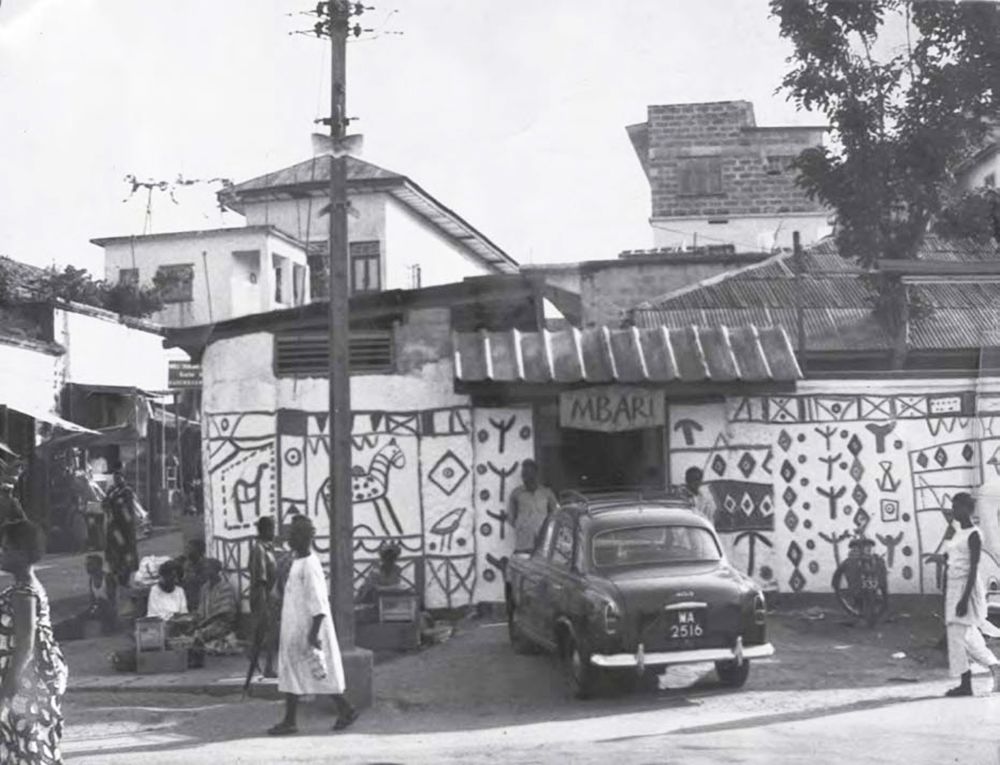
Burks, C. K. “Fostering creativity: Mbari Artists’ and Writers’ Club.” V&A blog, 2022.

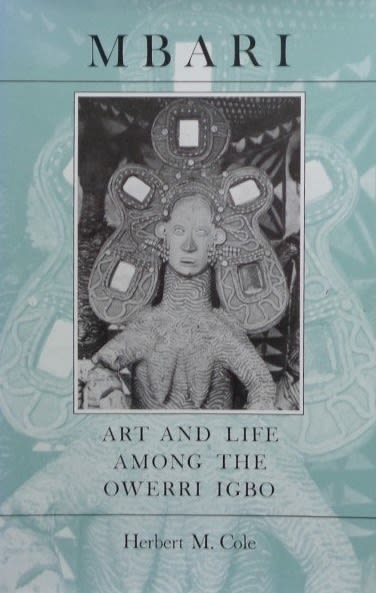
Herbert M. Cole
Cole, Herbert M. Mbari: Art and Life Among the Owerri Igbo. Bloomington: Indiana University Press, 1982.

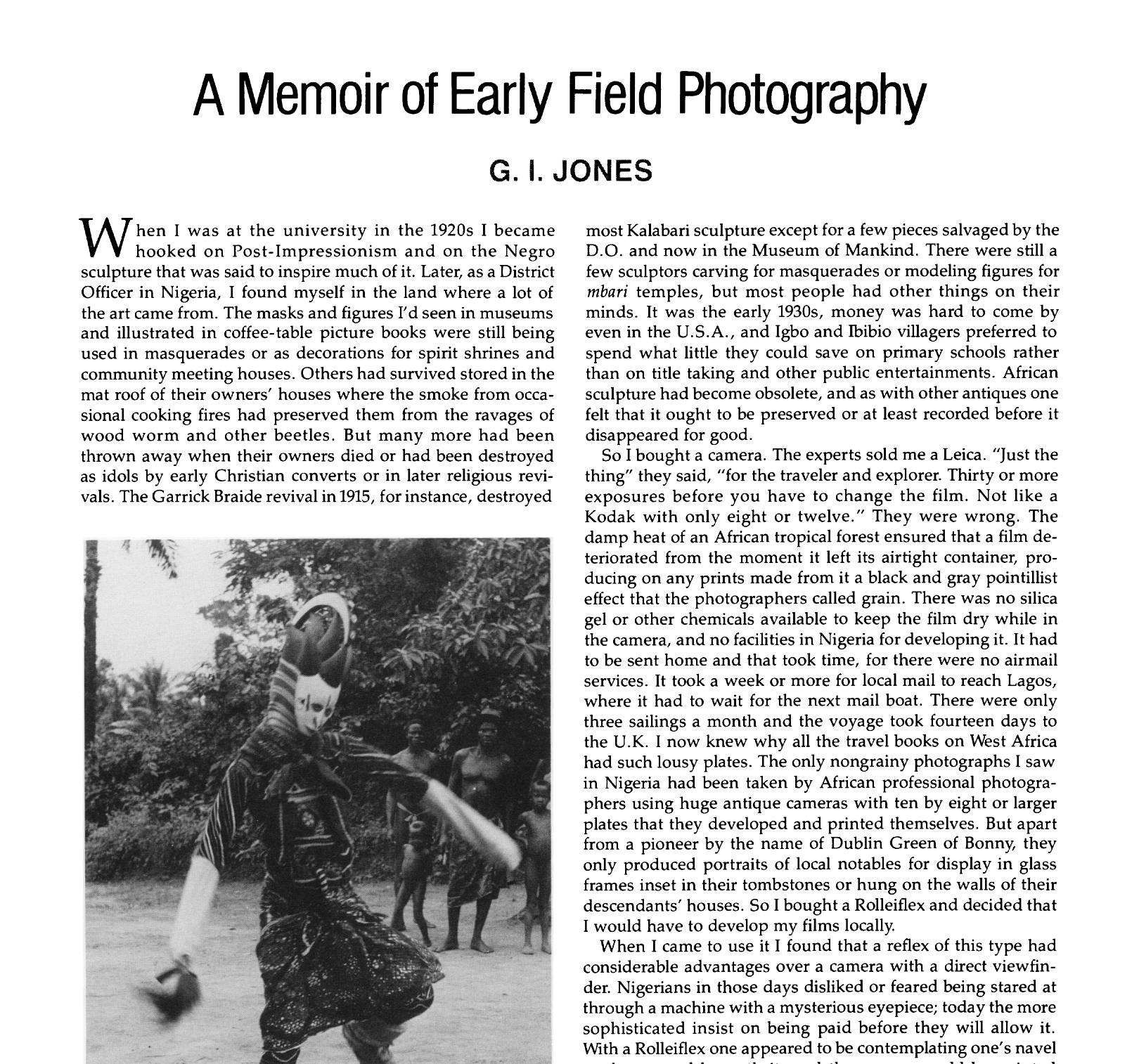
G. I. Jones
Jones, G. I. “A Memoir of Early Field Photography.” African Arts 18, no. 4 (1985): 64–67.

G. I. Jones
Jones, G. I. The Art of Eastern Nigeria. Cambridge: Cambridge University Press, 1984.

G. I. Jones
Jones, G. I. Ibo Art. Princes Risborough: Shire, 1989.

G. I. Jones
Jones, G. I. “Mbari Houses.” Nigerian Field 6, no. 2 (1937): 77–79.

John Okparocha
Okparocha, J. Mbari: Art as Sacrifice. Ibadan: Daystar Press, 1976.