Programme
John Field Nocturne No. 4 in A major
Fanny Mendelssohn Notturno
Maurice Ravel Noctuelles (Night Moths) from Miroirs
Frédéric Chopin Nocturne in E flat major, Op. 55 No. 2
Leoš Janáček Our Evenings from On an Overgrown Path
Francis Poulenc Phalènes (Moths), No. 5 of Nocturnes
Programme
Dmitri Shostakovich String Quartet No.4
Ludwig van Beethoven String Quartet, Op.135
Schnittke String Quartet No.3
About Quartetto Noûs
ENRICO FILIPPO MALIGNO, VIOLIN
ALBERTO FRANCHIN, VIOLIN
SARA DAMBRUOSO, VIOLA
MATTEO BASSAN, CELLO
The much-anticipated Cambridge Botanic Lights returns for its fourth year, transforming Cambridge University Botanic Garden into a spectacular illuminated trail celebrating the extraordinary world of plants. This year’s event will again bring the Garden to life after dark with stunning displays and artistic interventions – creating a beautiful landscape for everyone to enjoy.
Come along to learn, engage and play, and discover what we can do to help conserve the fungal diversity around us.
Highlights include:
🍄A range of talks from expert speakers, covering fungal partnerships, their roles in agriculture, and how they inspire art
🔬Science stand with microscopes to discover fungi that live inside plants
🪵Learn about our local fungi with the Wildlife Trust for Beds, Camb & Northants
At the Whipple, our collection is brimming with objects that highlight LGBTQ+ histories and themes, showcasing the remarkable contributions of individuals and their stories throughout history. Each tour is uniquely crafted by our specially trained volunteer guides, who bring their own perspectives and creativity to the experience.
Intimate, subversive and often beautiful, Gupta’s work has been instrumental in raising awareness around the fight for queer rights internationally, particularly in India and the UK, laying bare the tensions between tradition and modernity, and public and private spheres. Life with a Camera will feature more than 130 works, spanning street photography, portraits, and commissioned and personal projects, reflecting a life of migrations between Delhi, Montreal, New York and his longstanding home in London.
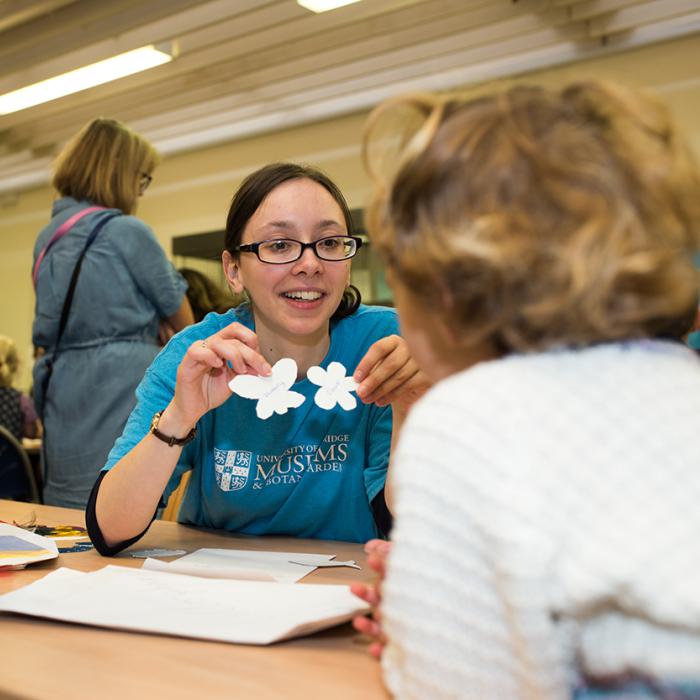
Come and make some beautiful artwork using different shaped leaves from the Garden.
Ages 3 +
Children must be accompanied at all times.
Free child tickets for this event must be booked online. Ticket sales open one week before the event. Adults do not need to book to accompany however please note that adults will be required to pay for Garden entry on arrival.
Exactly 120 years ago, Hertha Ayrton was awarded the Royal Society’s prestigious Hughes Medal, the first and only woman in the entire twentieth century to receive this honour.
A close friend of Marie Curie, Ayrton was an electrical engineer, mathematician, physicist and inventor, as well as an active suffrage campaigner. While a student at Cambridge’s Girton College, she also founded the College’s own Fire Brigade.
The Struggle for Light is a powerful new immersive exhibition created by The Glasshouse Artists, a community of artists brought together by Annabel Lee in collaboration with the University Herbarium and the Cambridge University Botanic Garden Learning Team.
Inspired by the remarkable but little-known work of 19th-century artist, writer and scientist Mary Merrifield, the exhibition explores creativity, resilience and the challenges women have faced in pursuing artistic careers across generations.
Celebrate the magic of butterflies and moths. We will be looking into their life cycles and finding out some fun facts about the ones that visit the Garden.
Ages 3 +
Children must be accompanied at all times.
Free child tickets for this event must be booked online. Ticket sales open one week before the event. Adults do not need to book to accompany however please note that adults will be required to pay for Garden entry on arrival.